The Arapuá indigenous land, located in the Alto Cauamé region, municipality of Alto Alegre, 90 km from Boa Vista, is one of the four lands pending demarcation in Roraima. The process is pending in the Federal Court of the State and has a recent decision giving a deadline for the National Foundation of Indigenous Peoples (Funai) to create the working group (WG) to carry out the socio-environmental, cultural and other contexts that will subsidize the demarcation process.
With the access through the RR-205 from Boa Vista, the route to Arapuá already shows the disastrous reality as a result of the expansion of agribusiness in the state, especially the soybean plantation. A reality that is seen in other municipalities such as Bonfim, extensive areas along the RR-401 and close to the indigenous communities destined for soybean plantation.
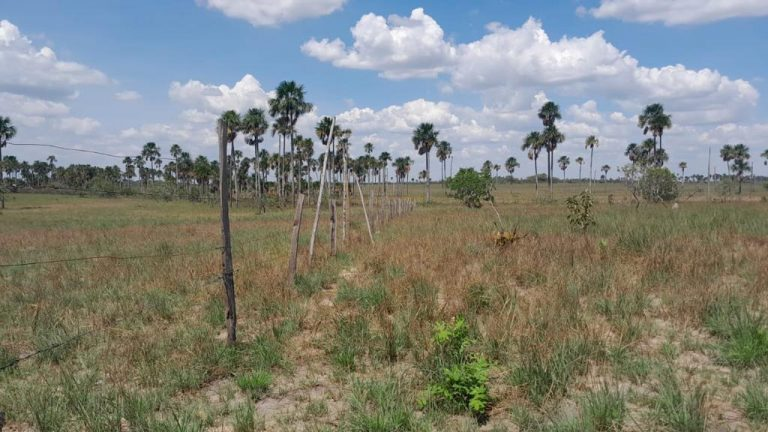
The natural landscape, known as ploughed, was overshadowed by the plough prepared for planting monocultures, such as soybeans and corn, as well as pasture for cattle. One of the main native plants of the plough, the caimbé, which was destroyed, or uprooted to make way for the latifundium that is growing more and more in the state, is no longer visible.
The Arapuá indigenous community, a place that resists the expansion of agribusiness, but also an example of environmental preservation and ancestral housing, will be the site of the Extraordinary Assembly and II Expanded Meeting of the Indigenous Council of Roraima (CIR). There are two events at the state level that will be held at the beginning of December.
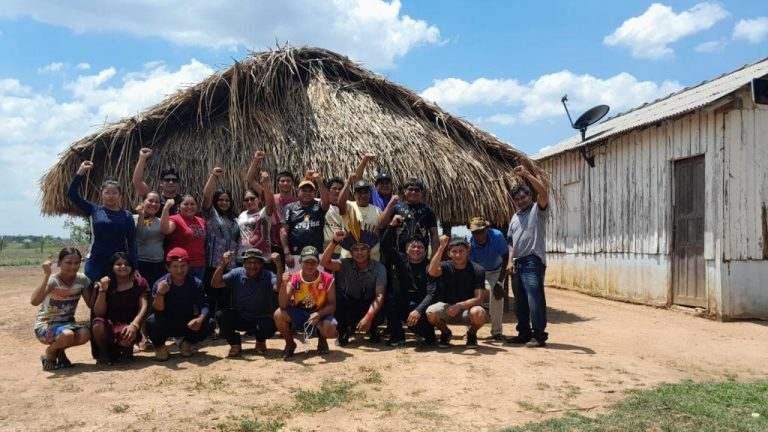
A delegation composed of the regional coordinators of the tuxauas and women, from the Raposa, Serra da Lua regions, in addition to the executive coordination of the CIR and the legal advisory, visited the Arapuá community last Saturday (28), to check the structure of the place, but, mainly, to reaffirm support for the struggle for the ancestral territory of the Wapichana and Macuxi indigenous peoples.
The difference in environment between the territory and the cattle pasture is great. Upon entering the Arapuá territory, it is possible to feel the wind that comes from the palm groves and the forest, which are still preserved. Meanwhile, in the plow and pasture, the scorching heat takes over an extensive area occupied by landowners.
The gates of the farms, sometimes locked with padlocks, which give access to the community reflect the climate of tension, threats and persecution. At the entrance that gives access to the territory, you can soon see the sign "forbidden to hunt and fish", signaling the invasion.
Passing through the gates and arriving at the community is a sigh of relief and at the same time hope. The buritizais, the streams that resist the drought, the traditional dwellings, many covered with inajá straw, typical of a Wapichana territory, reconciled with the people who speak their mother tongue, most of them Wapichana, are the greatest example of struggle, resistance and indigenous ancestry in Roraima and in Brazil.
Seeds for life
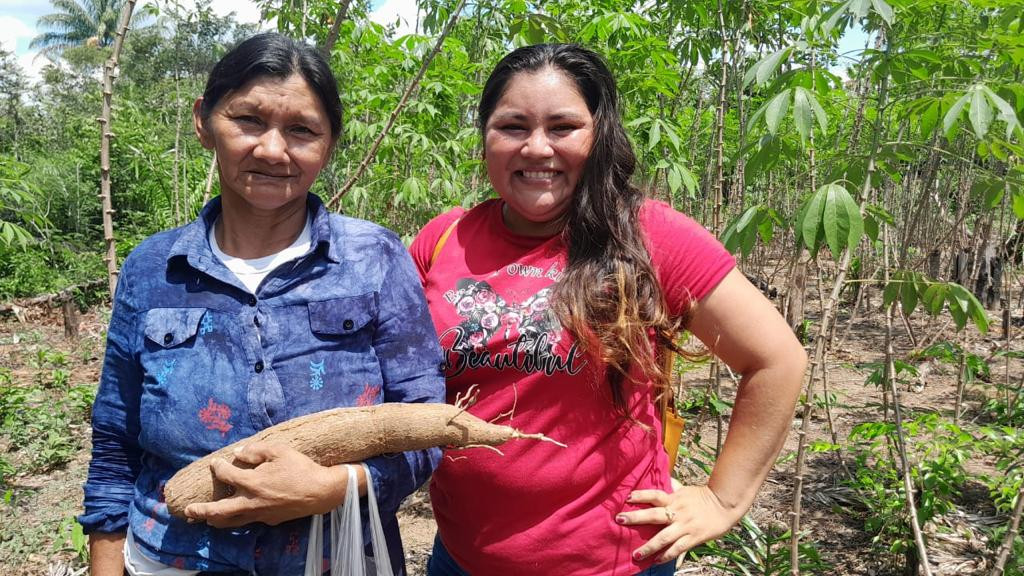
The motivation of women in the work of the community garden and the fertile soil for organic production are also components that symbolize this preserved traditional experience. On the occasion, led by the women, the regional coordinator Valtelina de Souza and the local Dalva Emiliano, the delegation visited the women's garden. There they grow cassava, manioc and other organic products.
Celebrating the moment of abundance and strengthening the initiative, the secretary of the Indigenous Women's Movement of the CIR, Kelliane Wapichana, delivered seeds from the Serras, Centro Willimon, Serra da Lua and other regions.
"We are delivering the sum of this diversity and this rich biodiversity that are our traditional seeds", stressed Kelliane when delivering the seeds. Highlighting the work of women, regional coordinator Valterlina de Souza, recalled the drought situation in the communities, where several are suffering from the loss of seeds and products, especially cassava.
"Today we are going through a moment of climate change. Many communities are still not able to have the plantation they used to, but here, thank God, we still have it, even with a lot of abundance. This is very good," said Valterlina, happy with the women's work in the fields.
Collective struggle for territorial recognition
During the visit and in the company of indigenous leaders from other regions of the state, Raposa, Baixo Cotingo, Serra da Lua, Amajari, Murupu and Tabaio, the community made a point of leading the delegation to the limit of the territory. The route from the center of the community to the limit was approximately 3 km, half of which is negotiated with a farmer in the region. Children, young people and women participated in this historic moment.
Just as the entire process of demarcation or territorial recognition was not and is not easy, for Arapuá it will not be either. But, to support this struggle, collective struggle, leaders such as Valério Eurico, regional coordinator of Raposa, from the Raposa Serra do Sol indigenous land, Alessandro Chagas, from the Serra da Moça indigenous land, Lázaro Alessandre, from the Manoá-Pium indigenous land, and other lands already demarcated, were in the territory reaffirming support.
"We are here in the Arapuá indigenous land, a very small land. Compared to the Raposa Serra do Sol indigenous land, here it is very small, but we are here to support and strengthen the work for demarcation," said Eurico.
From the Serra da Moça indigenous land, Murupu region, a region that also suffers from the advance of soy and other invasions, Alessandro reinforced the pride of being in the territory and seeing the strength of the people in fighting for the land. "It is a pride to be in the Arapuá community and to see the struggle of the people who live in 600 hectares. This is like tearing our skin from feeling the pain of the people who live here," said Chagas, recalling the struggle in the Murupu region. "Fear is part of the struggle, but we are here to bring our support," he added.
For five years, the Indigenous Council of Roraima (CIR) has been following the process of demarcation of the Arapuá indigenous land. For the third time in the territory, the indigenous lawyer and legal advisor of the CIR, Ivo Makuxi, was again and this time he brought the good news of the first steps in the processing of the request.
"We are happy to celebrate this small moment of advancement. Starting next year, Funai will have to come here to survey the Arapuá indigenous land and start the demarcation process. I am sure that we will celebrate this achievement of yours", celebrated Ivo, when informing about the decision of the court in favor of the indigenous people.
The decision to create the working group by Funai was the result of an agreement made between the Federal Public Prosecutor's Office, author of the request, the National Foundation of Indigenous Peoples (Funai), Federal Union, and the presence of community leaders and the Indigenous Council of Roraima (CIR), in a meeting on September 14 of this year. It was a first positive and favorable result for the community of Arapuá.
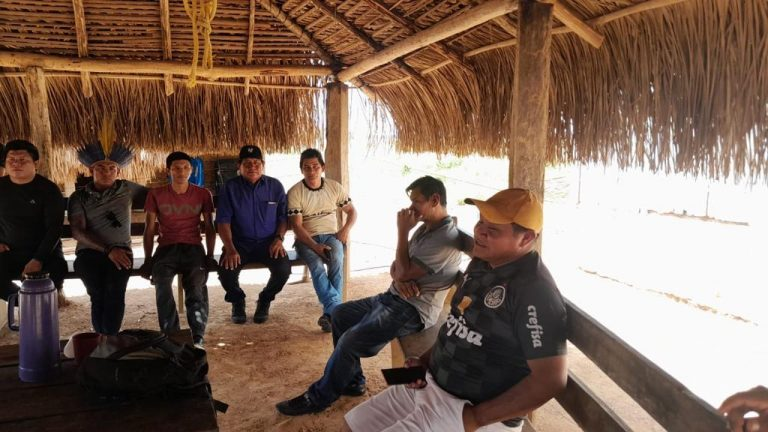
The general coordinator of the CIR, Edinho Batista, when talking about the visit to the community, the site of two events, reinforced that it was also to strengthen the community. "Our presence is to strengthen the community to really recognize that this is indigenous territory and where there have been people for a long time", he strengthened.
With a happy face, Tuxaua Gustavo Fernando, 61, when leaving his considerations, made a point of speaking in the traditional Wapichana language. Translated by Professor Joice Wapichana from Novo Paraíso, Gustavo thanked the leaders for their presence and reinforced that this is the traditional territory.
"They took our land, the whites took our land and left us without land to live on," reported the Tuxaua, the reality of the community confined between soy and cattle pasture.
The current area is 600 hectares and the community claims approximately 27,946 hectares, an extension that takes up much of the forest, streams, game and other sources of subsistence. "Today we can't fish, we can't take wood, we can't do anything here. But today I'm very happy because the relatives came here to strengthen us. That's how we have to live, we have to help our relatives from other territories," reinforced the Tuxaua.
In Roraima there are 36 indigenous lands, 4 of which are pending demarcation. In Brazil there are more than 400 requests, according to data from the National Foundation of Indigenous Peoples (Funai).
Arapuá, with 17 families and 57 people, even confined between soy and cattle pasture, is an indigenous land of traditional and historical occupation. For years, they have been demanding demarcation.