
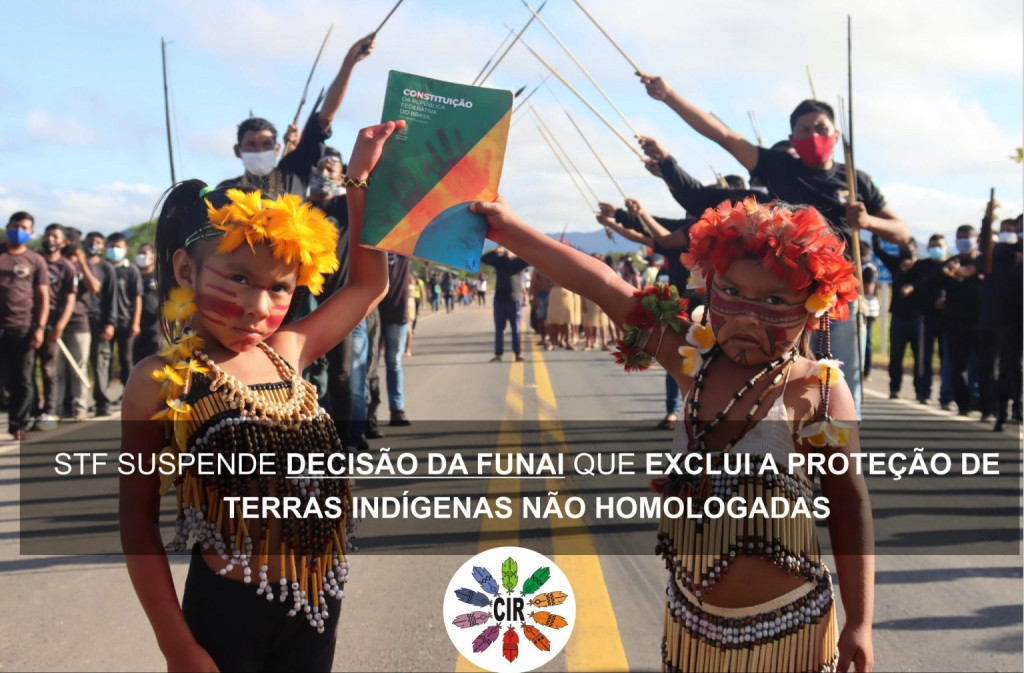
On February 1, the Minister of the Federal Supreme Court (STF) Luís Roberto Barroso, Rapporteur of the Allegation of Non-Compliance with a Fundamental Precept (ADPF) 709, suspended the decision of the National Indian Foundation (Funai) that excludes from the competence of the agency, the activities of protection of Indigenous Lands that have not been approved. This is Circular Letter No. 18, dated December 29, 2021.
The minister's decision responds to a request made by the Articulation of Indigenous Peoples of Brazil (APIB), which also filed a complaint with the Federal Public Ministry (MPF) against the Federal Agency's act. Another 15 indigenous organizations in the country also filed a request with the MPF for administrative impropriety against Funai, including the Indigenous Council of Roraima (CIR).
The measure taken by Funai was published by the General Coordinator of Territorial Monitoring, Alcir Teixeira, to guide the Regional Coordinations, the Environmental and Territorial Management Services (SEGATs), in addition to the Local Technical Coordinations (CTLs).
The decision came from a legal understanding of the Specialized Federal Prosecutor's Office (PFE), of Funai itself. In which, it conditions the execution of territorial protection activities to Indigenous Lands, only after the end of the administrative demarcation procedure. That is, only after the ratification of the demarcation made by Presidential Decree and the real estate registration in the name of the Union.
The legal advisor of the CIR, Ivo Makuxi, points out that Funai made a document, the Circular Letter, where all employees were being instructed to act only in case of invasion and territorial protection only in areas where they are already approved. He cites as an example the communities Lago da Praia, Arapuá, Pirititi and Anzol, would be without protection because it is not an approved indigenous area.
"Several indigenous lands would be at the mercy of the landowners. So they would be unprotected, because it is a very serious situation. And APIB analyzed that it was important to inform the STF that Funai had this understanding, contrary to the Supreme Court's own decision. In which it has to play its constitutional role, which is the Union's obligation to protect indigenous lands. And the STF's decision is that if there are indigenous people residing in the places, then it is indigenous land regardless of demarcation and homologation. It is up to the State to recognize this," said Ivo.