
Indigenous communities present concrete results in eleven years of implementation
The management of territories is an ancient tradition of indigenous peoples. Wisdom that passes from generation to generation, and that keeps traditional customs and practices alive
In recent years, the Indigenous Council of Roraima (CIR), through the Department of Territorial and Environmental Management (PGTA) and partners, has been dedicated to supporting indigenous communities in the construction of their Territorial and Environmental Management Plans for Indigenous Lands (PGTAs). A unique model of recording the communities' life plan on paper, based on the perceptions and visions of the indigenous people themselves.
And, after eleven years, with PGTAs built in all the indigenous lands of Roraima, the process of reviewing these plans has arrived. After the revision of the plan for the Serra da Moça indigenous land, they have now revised the PGTA for the Boqueirão and Mangueira indigenous lands, in the Tabaio region.
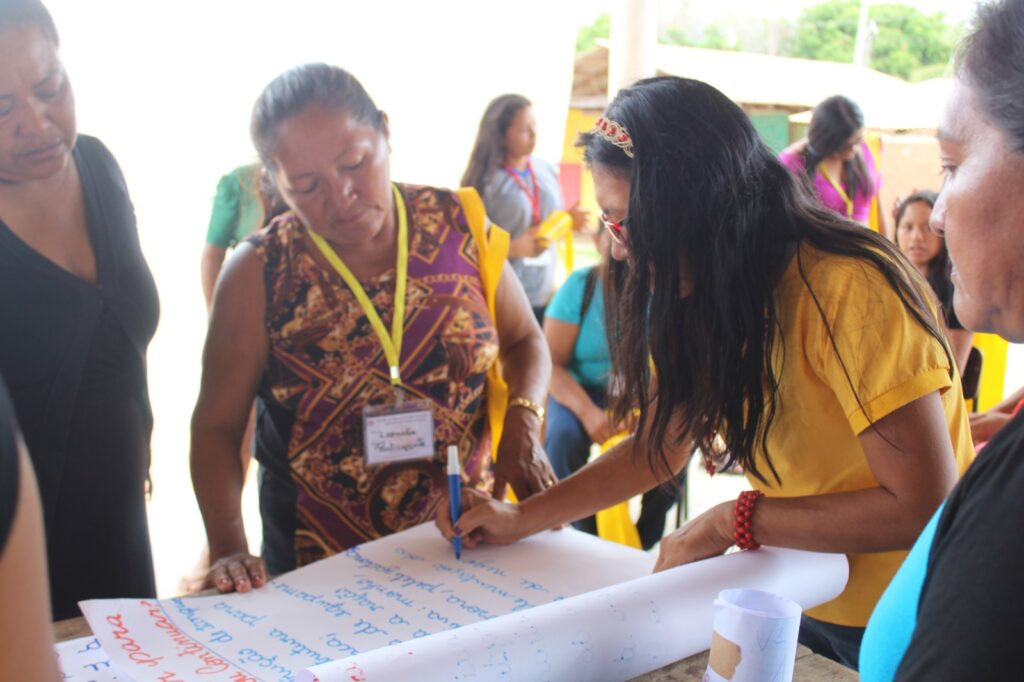
For this activity, the Review Workshop took place in the first week of May, 4 to 8, in the Boqueirão indigenous community, Tabaio region, with the presence of indigenous leaders from the two indigenous lands. The five-day program of activities involved the memory of the construction of plans, group work, evaluation, proposals, and other activities.
Among the participants were the leaders who contributed to the elaboration in 2013. Former regional coordinator of Tabaio and former tuxaua, Cosmo Viriato, is one of the leaders who made a point of being present at the activities.

Analyzing the implementation of the PGTA of the Boqueirão Indigenous Land, Cosmos said that it was very important and that some actions worked, even with the difficulties. In his assessment, the PGTA strengthened the actions already carried out and pointed out that one of the current needs is the expansion of the indigenous land, structuring of the firefighters and territorial protection. "I am very happy, because we were able to mobilize and continue this work by proposing more actions, such as the firefighters who are important for our region," said Cosmo, recalling the period of fires that the State faced and affected the region.
Another leader of the indigenous land who accompanied from the beginning was the Indigenous Territorial and Environmental Agent (ATAI), Alexandre Apolinário, from the Boqueirão indigenous community. When making an overview of the eleven years of PGTA of the Boqueirão Indigenous Land, Apolinário highlighted the actions that worked such as the fish farming project, with the breeding of tambaqui fish, where 4 tons were sold to the National Supply Company (Conab), the traditional medicine project, for young people and the cattle farming project, one of the most powerful in the region, with the structure of the pasture to strengthen the breeding and management of cattle.
With the confrontation of external pressures such as illegal mining in the Yanomami indigenous land, using the Boqueirão indigenous land as a route, another important action mentioned was the strengthening of the monitoring and surveillance base. These are actions that only with the plan were they able to implement in the territory and the expectation with the review is to strengthen these actions more and more.
"It was only with the plan that we got all these partnerships to solve some problems and also strengthen sustainability within the community through fish farming, traditional medicine, cattle farming. We hope to strengthen partnerships more and more, structure projects and innovate those that need to be implemented", said Apolinário.
During the activity, the PGTA of the Mangueira indigenous land was also reviewed, focusing on the implementation of the organic coffee project. Terezinha Agostinho, a resident of the community, followed the construction of the PGTA from the beginning, especially the implementation.
To advance the project and improve working conditions, materials such as grinding machines, brush cutters and other objects were purchased. In addition to coffee, there is also the project of youth initiatives.

Terezinha reinforced that in the review the proposal was to seek more implementation of the project. "In this review we intend to implement the coffee project with a mechanized area, with technical monitoring, but always maintaining an organic and healthy plantation, both coffee and another crop", stressed Agostinho.
In addition to coffee, the community also managed to implement the traditional medicine project, acquiring equipment for the kitchen, used in the preparation of medicines. "And we are happy because we have support from the CIR, from our organization. The PGTA has been a great potential because it brought something that it had not known about, it brought what we did not have in the community. It has been a great partner", she added, satisfied with the results.
By reinforcing the importance and how the management plans or life plans of indigenous communities are built, the coordinator of the Department of Environmental and Territorial Management (ATAI), Sineia Bezerra do Vale, elected at the last Climate Change Conference in Dubai as co-chair of the Indigenous Caucus for Latin America and Karibe, reaffirmed that the construction begins from the experiences of the struggles of the leaders for land and that they only put on paper, their knowledge, the management plans in the areas of health, education, monitoring, the environment, women, young people and all forms of experience in the territory, especially the conservation of nature aligned with traditional knowledge.
For the construction of the PGTAs of the indigenous lands of Roraima, the CIR used its own methodology that is the dynamic of "learning and doing together", involving the members of the communities from the children to the elders, the oldest leaders of the community, who put their management plan on paper. It is not an activity done from top to bottom, but to apply the methodology of the communities.
"It is a plan that is not static, we review in time and time, what has advanced. We created our own methodology for reviewing the plan, what were the good and bad results, and now including new actions. Indigenous communities are the ones who review it", clarified Sineia, about the process of implementation and review of the PGTA.
A novelty of this review phase is the separation of the plans, according to Sineia. The PGTAs were prepared in a single document and will now be printed separately, for the respective indigenous lands.
In March, the CIR participated in the seminar on the PGTAs of the indigenous lands of the Brazilian Amazon, in Manaus. The general Tuxaua of the organization, Edinho Batista and Sineia, shared the experiences of the 26 PGTAs built in Roraima.
When analyzing the process during the eleven years, Sineia highlighted two aspects that make the difference in the PGTAs of Roraima, the methodology itself and the use of technologies, used in the construction of geographic maps of indigenous lands. This makes it possible to build the plan in the short term, without the need for a duration of one or two years to complete.
The last construction was of the Sucuba (Alto Cauamé), Truaru (Murupu) indigenous lands and the regions, Amajari and Tabaio, which lasted only 10 days. "This proves that it is possible to build the PGTA in 10 days," said Bezerra.
"Technology together with traditional knowledge has made a difference because when we bring the mind maps and we have the geographic georeferencing system, our technician who organizes everything, it is proven that we do not need one or two years to build a plan that we are already building in people's heads, including placing demands for public policies that already do this constantly, this search for rights, policies. So this is the differential of Roraima's life plans", he considered.
The activities bring together partner institutions and entities. In the review, the CIR had the contribution of the Insikiran Institute of the Federal University of Roraima (UFRR), through the Indigenous Territorial Management (GTI) course, which from the beginning participates with students and professors.
"In this eleven-year experience, we have seen that the implementation has been from the organization and the community, and public policies have not yet arrived in a more concrete way. We have to charge for it to happen", evaluated Professor Herundino Ribeiro, coordinator of the Course.
The CIR has been a reference at the regional, national and international levels in discussions on climate change, land management and defense of rights. For the general tuxaua, Edinho Batista, the PGTA will serve in the short, medium and long term, and reinforced that "it is necessary to use wisely, a project that is not only for today, but for the future".
Over the eleven years, the organization has built a relationship of partnerships, both with public institutions and non-governmental entities, which were fundamental in the preparation and implementation of the PGTAs. In this last review, the CIR had the partnership of Nia Tero, an entity that works with traditional peoples and populations in the Brazilian Amazon and other places in the world.
