
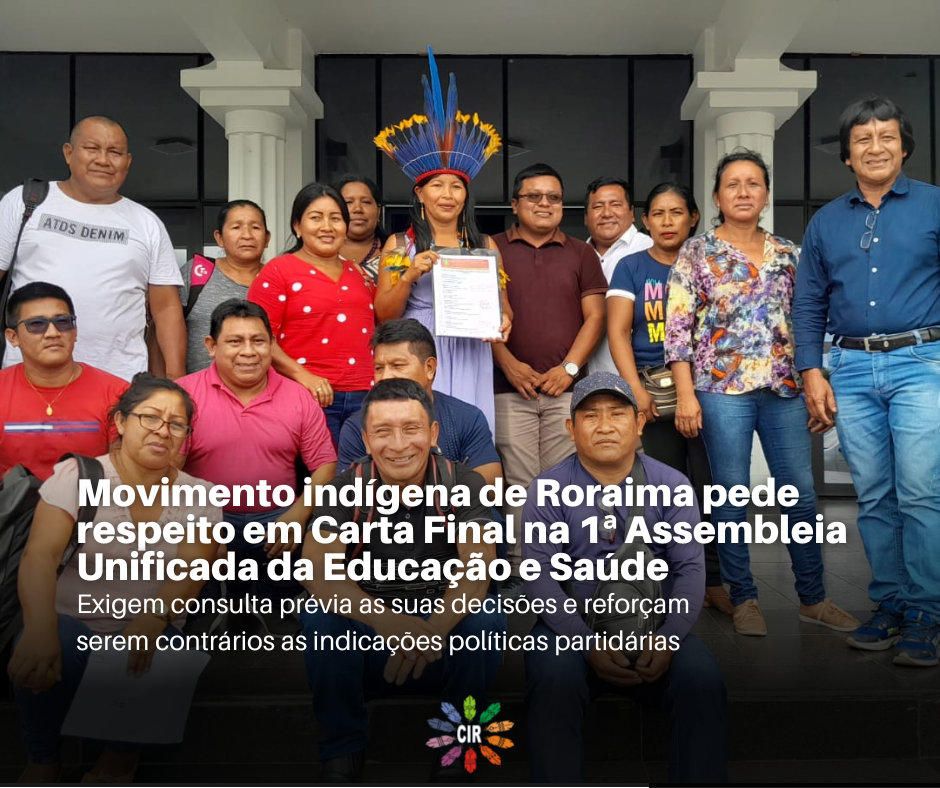
They demand prior consultation for their decisions and reiterate their opposition to partisan policy directives.
The Indigenous Movement of Roraima held its 1st Unified Assembly on Indigenous Education and Health from February 12th to 17th. The theme was: “Resuming Autonomy in the Organizational Processes of Differentiated School Education and Indigenous Health.” The meeting revisited old and new problems. With the new federal administration, the movement had been organizing for this important assembly. In a closing letter, the movement's opposition to political appointments made it clear that decisions made by the State Government of Roraima or its secretariats would not be accepted without prior consultation with the tuxauas (chiefs) and regional assemblies.
The assembly brought together more than 1000 leaders from the Macuxi, Wapixana, Sapará, Yekuana, Ingaricó, Wai Wai, Taurepang and Yanomami peoples, including representatives from the Association of Indigenous Peoples of Roraima - APIRR, the Organization of Indigenous Women of Roraima – OMIR, the Organization of Indigenous Teachers of Roraima-OPIRR, the Association of the Wai Wai Indigenous People-APIW, the Association of Indigenous Peoples of the São Marcos Indigenous Land – APTSM, the Council of the Ingaricó Indigenous People – COPING, ALDCIRR, the Indigenous Council of Roraima – CIR, SODIURR, TWM and Regional Coordinators, Traditional Medicine Coordinators, Students from the INSIKIRAN Institute of Indigenous Higher Education, Indigenous Health Professionals, Indigenous Health Agents, Indigenous Sanitary Agents, Community Health Agents, Microscopists, Clinical Analysis Technicians, and Technicians. Nursing staff, Nurses, GPVTI (Indigenous Territorial and Environmental Management Group), Indigenous Territorial and Environmental Agents, Teachers, State and Municipal School Managers, Collective Health and Indigenous Territorial Management Managers, Shamans, Local and District Health Councilors, Animators, Legal Professionals, Tuxauas (Chiefs), Mediators and Conciliators, President of Local Health Council, Indigenous Advisors, Traditional Animation Group, Cattle Project Coordinators.
The letter includes requests for new appointments to the Special Indigenous Health District (DSEI) and the Indigenous Education Division, since the current administration (education) has been acting against indigenous leaders, in addition to defending illegal mining on indigenous lands as a "self-management policy," contradicting the position of the Indigenous Movement of Roraima, which has been fighting against illegal mining for years.
The letter, still on the subject of education, outlines 28 demands, among them: That the State Department of Education urgently conduct a specific selection process for teachers of native languages. Indigenous teachers have long been dissatisfied with the department, as they are not allowed to participate in assemblies like this one and are generally marked absent even after prior justification. That the State and Municipal Departments of Education respect the participation of all education professionals in the Assembly of Indigenous Peoples. That the municipal councils co-officialize and approve the existence of the indigenous languages Macuxi, Wapichana, Yanomami, Sapará, Yekuana, Wai Wai, Ingarikó, Patamona, and Taurepang, according to their ethno-territory.
Regarding health, considerations focused on the relationship between the main means of care for the indigenous peoples of Roraima: the Special Indigenous Health Districts – DSEI – East and Yanomami, and the Special Secretariat for Indigenous Health – SESAI, both of which have long been involved in scandals such as the smuggling of medicines, lack of transportation and maintenance, and a reduction in the number of agents. Distributed across 102 points requiring change are: The leaders of the 34 base centers of the DSEI/East will not accept the entry of an incomplete team; That SESAI recognize and value the category of traditional medicine professionals, shamans, healers, and midwives;
Still showing concern for the Indigenous Health Center – CASAI – RR, the leaders also requested continued support for the center, which currently houses leaders of the Yanomami people, providing care until they return to their communities, and serves leaders from all Indigenous Territories in the state.
Check out the complete document filed by the leaders at the State Government headquarters and previously distributed and delivered to other regional leaders and competent authorities.
Here is the letter:
FINAL LETTER ON INDIGENOUS EDUCATION AND HEALTH 2023 - ALDENIR - REVISED