
Next Monday, August 5th, the Supreme Federal Court (STF) will begin the work of the special commission created to mediate the conciliation process related to Law 14.701/2023, approved by the National Congress in 2023, which adopts the time frame for the demarcation of indigenous lands, in addition to other actions that threaten the rights of indigenous peoples.
In June, Supreme Court Justice Gilmar Mendes, rapporteur for the five lawsuits challenging Law 14,701/2023, suspended proceedings and decided in favor of conciliation, summoning the plaintiffs to the first hearing. Mendes highlighted the points to be discussed in the conciliation, "the recognition, demarcation, use, and management of indigenous lands."
There are three actions arguing unconstitutionality (Direct Action of Unconstitutionality - ADI 7582, 7583, 7586), one arguing constitutionality (Declaratory Action of Constitutionality – ADC – 87), and one declaratory action (Declaratory Action for Omission – ADO – 86) asking the Supreme Federal Court to declare the omission of the National Congress in applying the law, mainly items of article 231, which points to the possibility of projects such as mining, construction of hydroelectric plants and energy transmission lines on indigenous lands.
The lawsuits alleging unconstitutionality were filed by the Articulation of Indigenous Peoples of Brazil (APIB) and six political parties: Rede Sustentabilidade, Workers' Party (PT), Brazilian Communist Party (PCB), Green Party (PV), and Democratic Labour Party (PDT). The lawsuit alleging constitutionality and omission was filed by the Progressive Party (PP), Republican Party, and Liberal Party (PL).
In a decision issued in April of this year, suspending all actions, the Minister determined a joint process, adopting a timeframe from August 5th to December 18th, 2024, beginning with the first hearing, to conclude the work. Invited to the hearing were members of the National Congress, Senate and Chamber of Deputies, representatives of the Union, such as the Attorney General's Office (AGU), the Ministry of Justice (MJ), the Ministry of Indigenous Peoples (MPI), and the National Foundation for Indigenous Peoples (Funai), representatives of the States and Municipalities, and the plaintiffs in the actions.
APIB is expected to participate with six representative members and five more from the base regions. The hearing will be held in a hybrid format (in-person and virtual) and conducted by the technical rapporteur of the Supreme Federal Court.
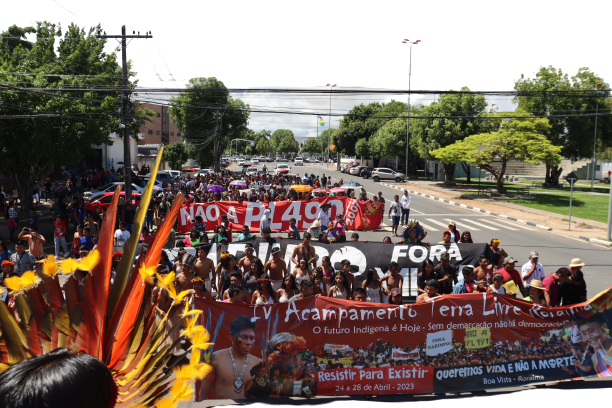
In Roraima – To protest against Law 14.701/2023 and the attempt at conciliation in the Supreme Federal Court (STF), the indigenous movement of Roraima is organizing another mobilization starting on Sunday, August 4th, at Praça Ovelário Tames Macuxi, in Boa Vista.
With the participation of indigenous leaders from various regions of the state, the movement organizes marches, plenary sessions, exhibitions of community production, and cultural presentations. The main march will be on the 5th, the day of the hearing at the Supreme Federal Court.
In addition to the temporal framework, a thesis that was largely rejected by the Supreme Federal Court itself, the indigenous movement must also protest against the lack of free, prior and informed consultation, invasions of indigenous lands, the weakening of the exclusive usufruct of indigenous peoples over their lands, and against attempts to change and alter the main article of the Constitution that guarantees the rights of indigenous peoples, article 231.
Even though the minister suspended the actions and called for a conciliation meeting, the indigenous movement in Roraima understands that there is no conciliation or negotiation of rights already guaranteed in the Constitution, especially territorial rights. The collective demand is to comply with the Constitution and not to negotiate acquired rights.
In Roraima and throughout Brazil, the reality in these territories demonstrates in practice the application of the "marco temporal" law, where the process of mineral exploration, leasing, invasion of territories, and consequently, violence against indigenous peoples is already underway.