
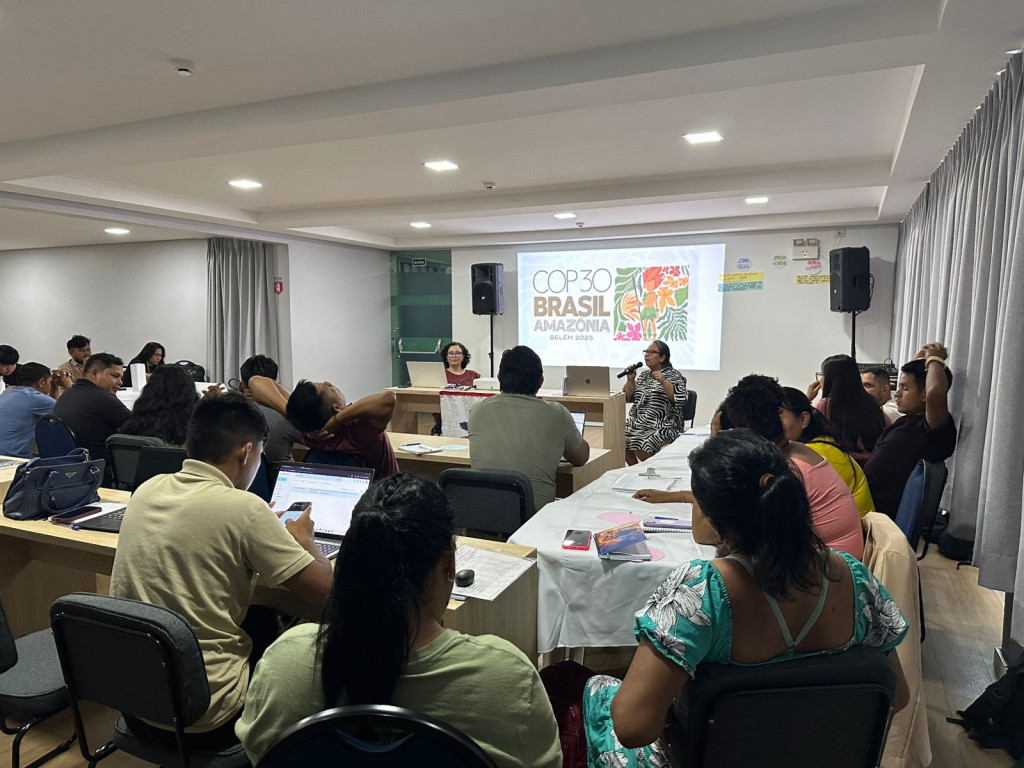
The Indigenous Council of Roraima (CIR), through the Department of Territorial, Environmental and Climate Change Management (DGTAMC), will hold a training course on October 27 and 28, 2025, aimed at participants who will represent the indigenous peoples of Roraima at the 30th Conference of the Parties (COP 30) of the United Nations (UN), which will take place in Belém, Pará.
The training session brings together leaders from CIR, as well as the representative of the Hutukara Yanomami Association (HAY), Matthieu Lena, to align proposals and strategies for the Climate Conference. The meeting is taking place in the auditorium of the Blue Inn Hotel in Boa Vista and aims to organize the leaders' trip, align proposals, and strengthen the collective work of the Roraima indigenous delegation for the international event.
The workshop is led by the coordinator of DGTAMC, co-chair of the Caucus and special envoy to COP 30 in Brazil, Sineia do Vale, and by international advisor Patrícia Zuppi. On the second day, the communicator from the Coordination of Organizations of the Brazilian Amazon (COIAB), Pedro Tukano, will present the campaign “The Answer is Us” and the NDC, an acronym for Nationally Determined Contribution.
According to Sineia, a delegation of approximately 40 leaders will be present. The meeting aims to prepare the delegation and share important information about the different spaces of the conference, such as the Blue Zone, the Green Zone, the COP Village, the People's Summit, and the Indigenous Peoples' Summit. She explained that preparation is essential to ensure effective and well-organized participation during the conference.
“This moment is very important because we are meeting with the leaders of the Indigenous Council of Roraima and also with representatives of Hutukara. A delegation of about 40 indigenous people from Roraima will go to participate in COP 30 in Belém. This preparatory meeting serves to bring important information about how we will act in each area, such as the Blue Zone and the Green Zone.”, he explained.

During the two days of work, the leaders will get to know these spaces better, review the event schedule, and define how they will operate within each of them.“These two days are for us to understand the space, to know what events we have on our participation agenda and how we will be within these environments. This preparation is fundamental because it precedes the COP and guides us when we arrive there, regarding logistics, transportation, accommodation and activity planning.”, Sineia pointed out.
Another point addressed is the accreditation process, both for the meeting of the Platform of Indigenous Peoples and Local Communities and for access to the Blue Zone (paid parking area).“We are also discussing how accreditations arrive in our emails and the preparatory meeting for COP, the major climate change forum linked to the United Nations Framework Convention on Climate Change (UNFCCC), which will take place on November 8 and 9 in Belém.”he added.
The COP event is expected to bring together more than a thousand indigenous people and will be an important forum for organizing these communities around the global climate agenda.“We are connecting all the people from the Indigenous Council of Roraima and Hutukara so that they can get to know the spaces where they will participate. It is a moment of preparation, coordination, and unity among the indigenous peoples of Roraima.”"Sineia reinforced this point."


For her, this mobilization is fundamental to strengthening the indigenous presence in climate decision-making spaces."This preparation is essential to ensure that we arrive safely, organized, and with a clear agenda, representing the indigenous peoples of Roraima in the climate debates and decisions during COP 30.", he concluded.
Participants in the training include leaders from the Murupu, Wai Wai, Surumu, Amajari, Serra da Lua, Alto Cauamé, and Tabaio regions, as well as the CIR technical team and leaders from the Yanomami people.
“We are sharing information about how participation in the event will be structured and the activities we will be developing. The leaders are preparing their proposals to submit to COP, bringing a new proposal for adaptation to climate change. The state of Roraima is the only one that has a climate adaptation plan and will also present its indigenous brigade. Our expectation is that the demands will be met and that indigenous representation will be well-represented.”, highlighted the general tuxaua-general of the CIR, Amarildo Macuxi.
This is the first time that leaders have participated in a COP. The coordinator of the Surumu region, Raposa Serra do Sol Indigenous Land, Jesus Nazareno, highlighted the importance of the opportunity for learning and exchanging experiences.“My expectation is to share knowledge and seek further learning, because we are going through a critical situation with climate change. I want to seek more support for our communities.”, he said.
During the workshop, information was also presented about the official spaces of COP 30, such as the Blue Zone, the Green Zone, and the Indigenous Caucus, in addition to practical guidance on the role of the Roraima delegation during the event.
The activity has the support of the Institute for Climate and Society (ICS).