
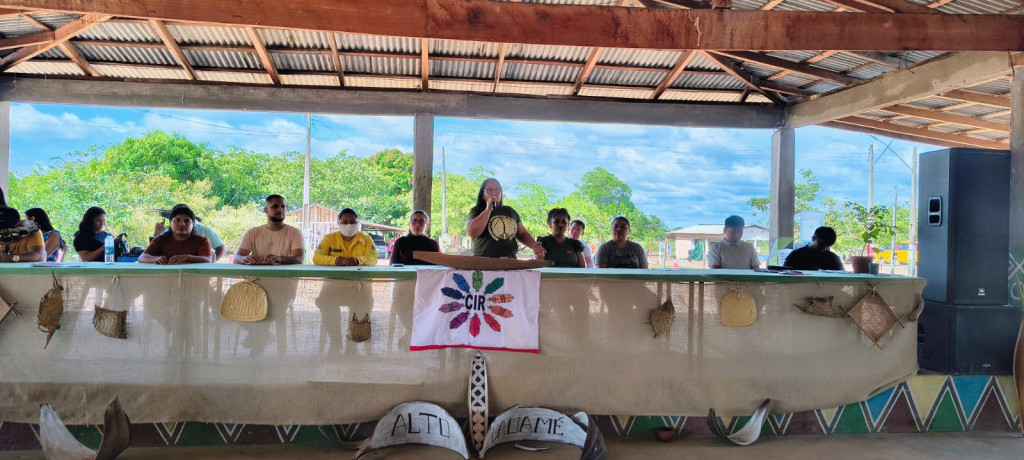
During the third day of the 10th Assembly of Indigenous Youth of Roraima, the Department of Territorial, Environmental and Climate Change Management (DGTAMC) of the Indigenous Council of Roraima (CIR) held a round table discussion on Climate Justice and Environmental Racism, focusing on the impacts on indigenous peoples and their participation in national and international spaces, such as COP30.
The activity was led by Sineia do Vale, from the Wapichana people, a leading figure in the indigenous environmental struggle, who began the conversation by asking the young people what they understood by climate change. The responses highlighted how these changes already directly affect their communities.
Sineia also presented a timeline of the Conferences of the Parties (COPs), explaining the importance of each one and how Indigenous peoples have sought to ensure their voices are heard in these global decision-making spaces. This moment reinforced the leading role of Indigenous youth in the fight for climate justice.

On the agenda, focusing on strengthening youth in spaces of struggle, professors Divo Marculino, Sandra Salustino, Aníbal Dimas, and Rávila Mota highlighted the challenges and the leading role of young people.
Youth have always been at the forefront of major transformations within the indigenous movement. Young people occupy spaces of struggle with courage, creativity, and resistance. However, to strengthen this presence, recognition is necessary; it is essential to guarantee real conditions so that youth have a voice, a place, and decision-making power.
"May the power that youth carries not be silenced. May the spaces of struggle also be spaces of welcome, learning, and transformation, where youth not only resist, but also dream, propose, and build.""Professor Sandra pointed out."