
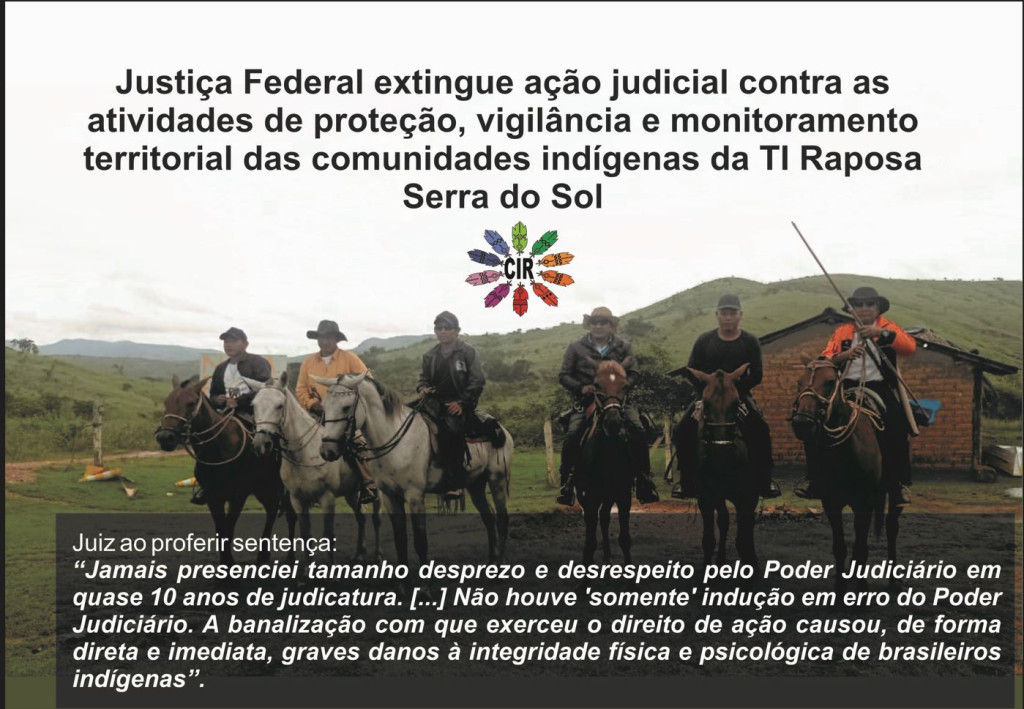
In a sentence handed down by the court of the 2nd Federal Court, the second lawsuit of SODIURR against the activities of protection, surveillance and territorial monitoring in the Raposa Serra do Sol Indigenous Land was extinguished without resolution of merit. In addition to extinguishing the lawsuit, the court considered that the activities are carried out due to the State's omission to promote the protection of indigenous peoples and lands against territorial invasion, illegal mining.
For the damages suffered by the indigenous communities, especially due to the actions of the PMRR, the judge ordered a fine to SODIURR, an investigation into the performance of its lawyer and recommended that the MPF file a lawsuit demanding compensation.
Check out an excerpt from the sentence of Judge Felipe Flores Viana:
I have never witnessed such contempt and disrespect for the Judiciary in almost 10 years of judicature. [...] There was 'only' misleading by the Judiciary. The trivialization with which he exercised the right of action caused, directly and immediately, serious damage to the physical and psychological integrity of indigenous Brazilians."
Which continued, verbalizing about the episode of police violence on 11/16/2021, in the Tabatinga community, T.I Raposa Serra do Sol, which left 12 indigenous leaders injured, through the use of lethal and non-lethal weapons:
"[The injunction] was duly complied with voluntarily on 08/18/2021, [...]. It turns out that, shortly after, SODIURR promoted a new request, [...] and even without the pronouncement of any judicial authority regarding this request, it was somehow truculently known and complied with by the PMRR [...] In any case, the procedural action of SODIURR was the cause of the direct combat between the PMRR and indigenous people, with police officers and indigenous people injured, who qualify as people in a situation of vulnerability."
LeadershipInjured in the attack on the Tabatinga Surveillance Post
And he continues:
"Although, in fact, the Military Police has the duty to act ex officio, many doubts and questions arise regarding the real reasons that led them to enter indigenous land (property owned by the Union, art. 20, XI, CR/1988) and what interests they were really protecting under the pretext of freeing up a state highway."
Regarding SODIURR, the judge determined that:
"In summary, it is verified by this demand how the irresponsible and abusive procedural behavior of a party can be pernicious and cause real harm to people. [...] In short, he manipulated and tried to adapt the judicial system to meet exclusively his interests, and it is certain that it is the people who must adapt to the established rules [...] Finally, I cannot fail to point out that it is strange to verify that one of the purposes of SODIURR established in article 2, II, of its constitutive act, dated 09/29/1993, that is, after the redemocratization, is the integration of indigenous people into Brazilian society, in order to end their social organization, customs, languages, beliefs and immemorial traditions for the purpose of acculturating them, clashing head-on with the constitutional policy of interaction provided for in article 231 of the Constitution of the Republic, and in article 8 of ILO Convention No. 169, adopting assimilationism as an ideology, without even making use of between the lines.
The judgment determined the extinction of the action (No resolution of merit), and also:
(i.) FINE TO SODIURR FOR BAD FAITH LITIGATION (intention to use the action for illegal purposes), AND ISSUED A FINE OF 10 (TEN) MINIMUM WAGES, DUE EXCLUSIVELY IN FAVOR OF THE CIR;
(II.) THAT THE OAB/RR INVESTIGATE WHETHER SODIURR'S LAWYER VIOLATED THE CODE OF ETHICS OF THE OAB STATUTE;
(III.) THAT THE MPF PLEAD IN COURT FOR COMPENSATION FOR MORAL AND MATERIAL DAMAGES SUFFERED BY INDIGENOUS COMMUNITIES AS A RESULT OF THE LAWSUIT AND POLICE ACTIONS IN THE INDIGENOUS LAND. THE ACTION CAN BE APPEALED.
In the Federal Court, in addition to this lawsuit, SODIURR filed a similar one that had a sentence in March 2020 with the same content. And it also filed a habeas corpus, which started in the state courts, was sent to the federal court and then extinguished.
In the state courts, he filed another similar lawsuit in the District of Pacaraima, and an identical one in the judicial shift in the District of Boa Vista. In other words, there were at least five lawsuits with similar content and all with the same result, extinguished without resolution of merit.
What determines the importance of this sentence, however, is that it was in the midst of this action that there were so many violations of the rights of indigenous peoples and such police violence. These were episodes of truculence that had not been seen in Raposa Serra do Sol since the times of the struggle for demarcation, in the 2000s.
The Vice Coordinator of the CIR, Enock Taurepang, thanked the recognition in court of the action of the indigenous leaders.
"This series of sentences was already expected by us, because it is very clear how everything happened, it is a total disregard for these people who made these decisions, but this proves that it is worth believing in justice, it is worth not doing, wrong things everything that the indigenous movement of Roraima does is very well thought out, it is not thinking about a single family, a single person, it is thought about the good living of indigenous communities. Too bad that many people don't understand this. Or they simply don't want to understand. But the Indigenous Council of Roraima is this organization that was created wisely, by the tuxauas, by the leaders and with a very clear purpose of defending, in fact, the collective right and not the individual right. So we congratulate justice, I congratulate the people who make these laws actually happen, and we will continue to fight, we will continue to speak the truth, even if it hurts many people, who only want to use our relatives. Once again, I congratulate you, the doctors for this decision-making, which was already expected by us and that we feel more strengthened knowing that the Brazilian state still fulfills its role as a Brazilian citizen. It doesn't matter if he is an Indian or a white. And we have to respect the law and our state is governed by such laws. And that we must know how to use them, in the best possible way without trying to mischaracterize the effects of such laws, orders that are inscribed in our constitution. So in addition, the Dias de Roraima Council is committed to continue in the struggle, to continue caring for the good living of the indigenous communities of Roraima." The Indigenous Territorial Surveillance and Monitoring Posts have acted jointly, in addition to the Indigenous Territorial Protection and Surveillance Group - GPVTI, the leaders unite voluntarily to protect their territory.