
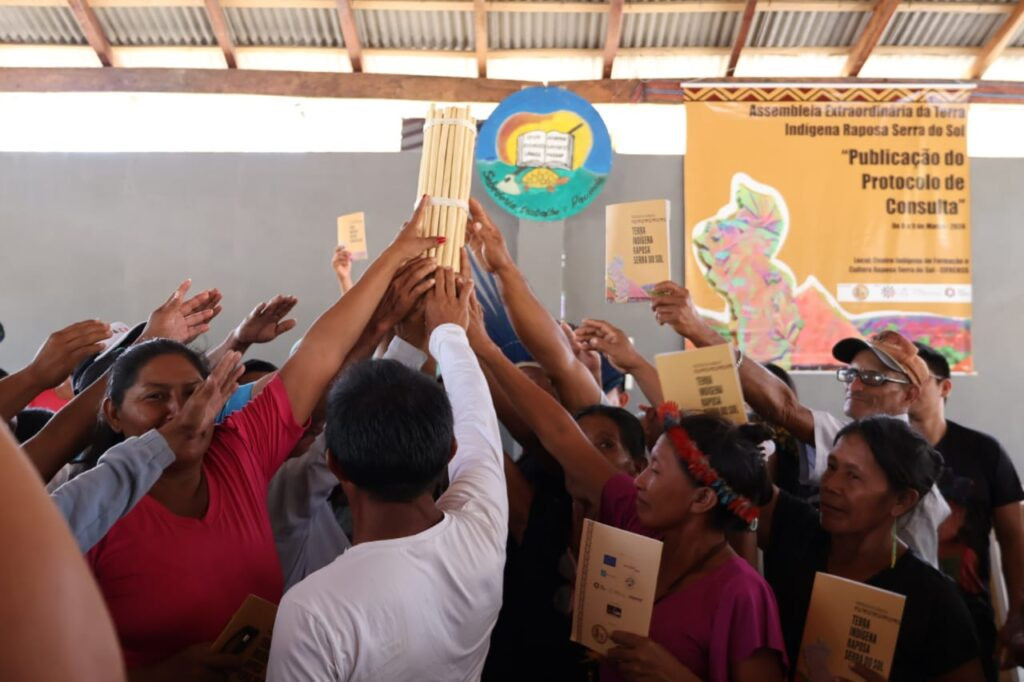
The peoples of the Raposa Serra do Sol indigenous land celebrate another historic achievement in the face of more than 30 years of struggle for the territory.
After 6 years of effective construction, they launched this Friday (8), the first day of the Extraordinary Assembly of the Raposa Serra do Sol Indigenous Land, the Consultation Protocol, a law that ensures and protects the rights, especially the territory, in addition to strengthening the autonomy and social organization of indigenous peoples.
The Assembly began today, at the historic Raposa Serra do Sol Indigenous Training and Culture Center (CIFCRSS), former Surumu mission, site of the first Tuxaua Assembly, in the decade of 1971, in the Barro indigenous community, Surumu region. The leaders continue until tomorrow, 9, with a debate on the current situation of the territory and evaluate the advances and challenges.
At the launch ceremony, the regional coordinator of indigenous rights operators, Francinete Garcia Fernandes, greeted the women for International Women's Day, celebrated today.
As protagonists of this achievement, more than 47 tuxauas (men and women) received copies, in addition to youth coordinators, from the Protection Group, Indigenous Territorial Surveillance (GPVTI), indigenous health agent (GPVTI) and other leaders. The Protocol has 59 pages, brings the history of struggle, social organization, constitutional laws and, mainly, the laws of the indigenous peoples of Raposa Serra do Sol.
"Consultation Protocol - maximum law of the Raposa Serra do Sol Indigenous Land"
The construction of the protocol is a demand of the indigenous communities of Raposa Serra do Sol, with the support of the Legal Department of the Indigenous Council of Roraima (CIR), together with a commission of leaders who accompanied the construction process, from systematization to the revision of the material.

During the memory of the construction of the protocol, the indigenous lawyer and coordinator of the Legal Department of the CIR, Junior Nicacio, reinforced the historic moment of putting the laws of the indigenous peoples of Raposa Serra do Sol, in a document that will serve to dialogue with the governments, but also strengthen the social organization of the peoples.
"It is the highest law of the Raposa Serra do Sol indigenous land, it serves inside and outside, to show how the peoples organize themselves. There are constitutional laws, which guarantee our right to consultation", he reinforced.
The document also records the history of violence against the indigenous peoples of Raposa Serra do Sol. Nicacio recalled three main forms of violence, the attack on the 10 Irmãos community, the destruction and fire of the Raposa Serra do Sol Indigenous Training and Culture Center (CIFCRSS) and the destruction of the Homologação, Retiro Tai-Tai, Jawari communities, acts that continue to go unpunished. The Protocol recalls the facts to ask for punishment, but also records the history of struggle and resistance for the territory.
He highlighted that the document is an instrument for dialogue with the federal, state and municipal governments. "It is an important document to dialogue with the federal, state and municipal governments. Any project that will affect the lives of indigenous peoples must be consulted," he stressed. "Raposa has a law, there has always been a law and now it is on paper, and the agencies need to respect this law."
"The Protocol is not to make construction unfeasible. On the contrary, it will help in the construction of public policies," added Júnior, reinforcing that projects such as electrification, monocultures and other projects need to be consulted with the communities.
The Raposa Serra do Sol indigenous land has five peoples, Macuxi, Wapichana, Taurepang, Patamona and Ingarikó, a population of 32 thousand indigenous people, four ethno regions, Surumu, Baixo Cotingo, Raposa and Serras, and more than 200 communities, Nicacio reinforced that the Protocol "respects cultural diversity and seeks to prevail collective decisions".
The president of the Local Council of Indigenous Health, Dioclecio da Silva Henrique, from the Barro community, Surumu region, as a member of the commission, upon receiving the material in hand, said that the Protocol is the right to be heard. "We are having in hand, the right to be heard. We have to be consulted. We have the right to answer, yes or no," he reflected.
The regional coordinator of women, Elinea de Souza, who is part of the commission, said that the Protocol is the indigenous law, a book, which will guide and give strength to leaders in conducting their work.
"This book is a law, to guide us and follow, to say no to non-indigenous people who arrive in our house anyway. This is a strength, a strengthening for us women, teachers, AIS and Tuxauas."
She recalled the "Go or Racha" struggle, on April 26, 1977, the first Assembly of the Tuxauas in 1971 and other historical acts, which will always be remembered and strengthened through the Protocol. She reinforced that there are still invaders in the Raposa Serra do Sol Indigenous Land, such as illegal miners and others, who will have to be faced with the use of the document. "There are still invaders on our land. I believe that the Tuxauas will strengthen themselves to say yes and no. It is our weapon," said Elineia, a teacher, one of the indigenous women who has always accompanied the struggle for the demarcation and ratification of Raposa Serra do Sol.
The historic moment is also a memorable act for the current generations of young people who follow their leaders and follow legacies. The young man and coordinator of Juventude da Raposa, Paulo Ricardo, was able to follow the construction and now pass it on to the youth.

"It is an honor as a young leader to be part of the commission, and of this historic moment. This strengthens us as Tuxaua, the region and especially our indigenous land", pointed out Ricardo.
Faced with the greed of the territory, such as mining, agribusiness and others, Paulo reinforced that the Protocol "is a fundamental tool to strengthen the struggle".
"This is a tool that makes me stronger, with the courage to fight against invasions. Today we are making it public to take another step in our struggle," said the general coordinator of the Raposa Serra do Sol indigenous land, José Arizona Menandro.
"They say 'the indigenous people are organizing', but we have always been organized, we are just putting it in the document," added the coordinator, who is experiencing another historical moment not only for the indigenous peoples of Raposa Serra do Sol (RR), but for Brazil.
"Every public institution needs to comply with this law"

To receive the Consultation Protocol, the National Foundation of Indigenous Peoples (Funai), the State Public Prosecutor's Office (MPE), the State Secretariat of Indigenous Peoples (SEPI/RR), the Diocese of Roraima, and indigenous organizations, the Association of Indigenous Peoples of Roraima (APIRR), the Association of Indigenous Peoples of the São Marcos Land (APITSM), the Organization of Indigenous Teachers of Roraima (OPIRR) and the Society for the Defense of United Indians of Roraima (Sodiurr) were also present.
The advisor to the presidency of the National Foundation of Indigenous Peoples (Funai), Martinho de Andrade, recalling his trajectory of struggle with the indigenous peoples of Roraima, which began in Raposa Serra do Sol, specifically, at the Indigenous Center for Training and Culture Raposa Serra do Sol (CIFCRSS), stressed that the Protocol is another cord of the bundle of sticks, a symbol of unity, struggle and resistance of indigenous peoples.
"This Consultation Protocol is one of the cords of the bundle, as well as the homologation, PGTA, women, teachers and partnerships. It is another cord and to join the bundle. This is reflected in the law of the communities and that we need to respect", pointed out Andrade, while also emphasizing that, when handing over to the indigenous public agency, the peoples give direction and tell Funai how they should walk and respect.
The first indigenous regional coordinator of Funai/RR, Marizete de Souza, originally from the Raposa Serra do Sol Indigenous Land, today, as a public manager, also reinforced that the moment is historic and reaffirmed her commitment to comply with the law.
"It is a historic moment. It is important for us to value the beam because it was from here that it all began. It will serve as a reference, a direction for the functioning of Funai, which will seek to comply with and respect the law that you are delivering to us", reaffirmed the coordinator, informing that there are several requests for projects and works, but she has been pondering, waiting for the Protocol to respond to the requests.
"Protocol is legal certainty"

The prosecutor of the State Public Prosecutor's Office (MPE), André Paulo, also endorsed the importance of the Protocol as an instrument that is already guaranteed in the Brazilian Federal Constitution and other international bodies, such as the International Labor Convention (ILO) 169.
"Indigenous peoples have their rights, but they are often not recognized. This Protocol is a legal certainty and any state authority has a way to know clearly how indigenous peoples make their decisions. It is more than a simple booklet, it is the materialization of indigenous rights," said the prosecutor, while also saying that it is the obligation as agents who supervise the application of the law, to respect indigenous laws.
One of the historical partners of the indigenous peoples of Roraima, the Diocese of Roraima. The Consolata Missionary, Father James Bhola, said that the "document in the hands shows total autonomy, which gives protagonism and the value of indigenous peoples".
The general coordinator of the Association of Indigenous Peoples of the São Marcos Land (APITSM), Marcelo Pereira, highlighted that it is an important tool for everyone, regardless of region, organization or people, and added that the communities of the São Marcos Indigenous Land are also starting its construction. "It is an advance for the indigenous peoples of Roraima. This will ensure the appreciation of all our leaders and that our rights are respected," said Pereira.
The view of indigenous leaders on the Consultation Protocol
At the delivery ceremony, traditional leaders, such as Desmano Afonso, Cleonice Macuxi, Tuxaua from the Jiboia community, both from the Raposa region, and Alcides Constantino, from the Surumu region and Elineia de Souza, from the Serras region, shared their trajectory of struggle and celebrated this achievement.
Leader Desmano Afonso, active in the struggle of the indigenous movement, said that he has always spoken of the Consultation Protocol, and today, he believes that they will work based on indigenous law, to act on several fronts, especially against invasions. "I believe that we will work on this, we will see how we will stop the invasions. Raposa Serra do Sol has been ratified and the invasions have not ended," said Afonso, worried, but with hopes of strengthening the struggle to guarantee the territory.
The tuxaua of the Jiboia community, a woman with a long history of struggle, confrontations and achievements, stressed unity and courage to continue the journey. She was in the well-known "Battle of Santa Cruz", more than 40 years ago, when there was a confrontation between the Army and the Santa Cruz community.
A reference in the struggle of the indigenous peoples of Raposa Serra do Sol, Alcides Constantino, remembering one of the people who faced Dr when they were barred by police and the army, accused him of being invaders and said that the law was not valid, and now, they have their own law. "We need to make them understand that we have our law. That was the dream of the tuxaua, to live on the land," he recalled.
"We suffered a lot. I hope that each leader has the courage not to lose our land and use this law to guarantee it," asked Constantino.
Source: Ascom/CIRFotos: Nailson Almeida (Wakywaa Network and Coiab)