
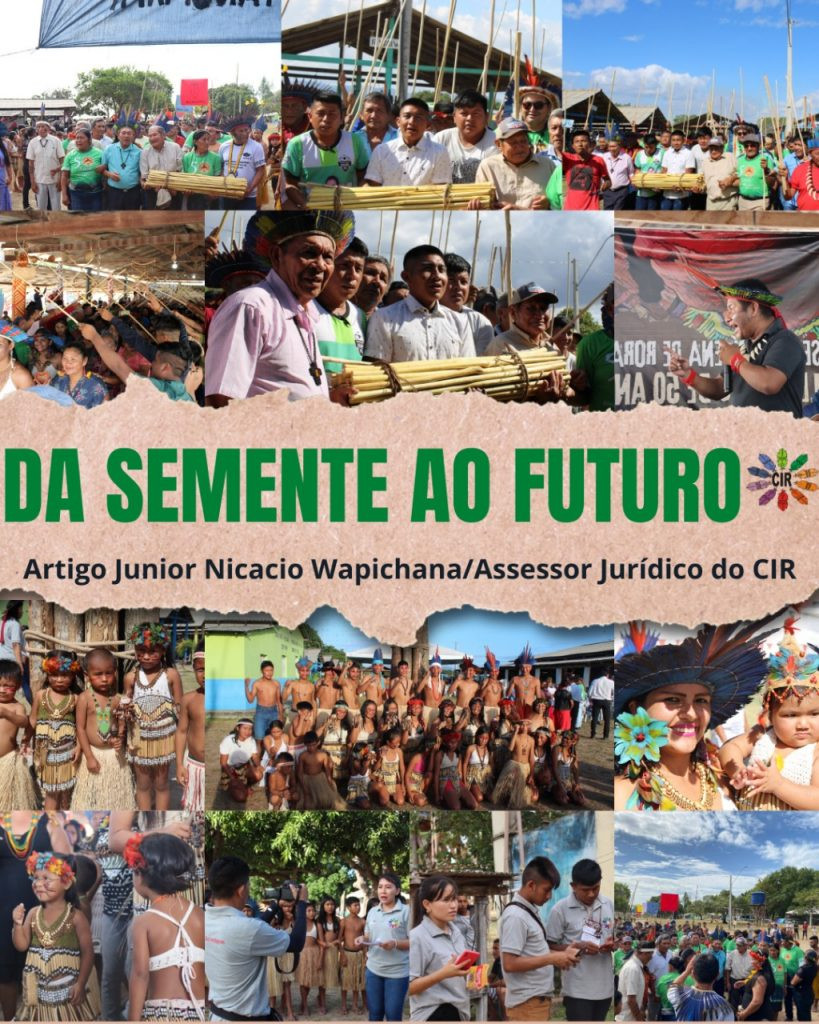
Good fruits are more resistant to pests – those of the land are even immune. Two years late, due to the Covid-19 pandemic, the Indigenous Council of Roraima (CIR) was finally able to celebrate its 50th anniversary, bringing together more than 2 thousand people in a sacred and emblematic territory: the Raposa Serra do Sol Indigenous Land. The seed from which the CIR sprouted was the first Assembly of the Tuxauas, held from January 4 to 7, 1971 – Tuxaua is the term that designates the leaders of the Wapichana communities. Together with the National Indigenous Union (UNI), the Federation of Indigenous Organizations of the Rio Negro (Foirn), the Coordination of Indigenous Organizations of the Brazilian Amazon (Coiab) and other associations, the CIR sowed the soil of the Brazilian indigenous movement.
HOW THE CLIMATE CHANGE IS AFFECTING THE MIGRATORY PATTERNS OF MARINE SPECIES, AND WHAT ARE THE POSSIBLE ECOLOGICAL AND ECONOMIC CONSEQUENCES OF THESE CHANGES TOCOASTAL COMMUNITIES THAT DEPEND ON FISHING? CONSIDERING THE INCREASE IN OCEAN TEMPERATURES, THE ACIDIFICATION OF THE WATERS AND CHANGES IN SEA CURRENTS, WHAT ADAPTATION STRATEGIES COULD BE IMPLEMENTED TO MITIGATE NEGATIVE IMPACTS ON BOTH ECOSYSTEMS HOW MUCH FOR THE HUMAN POPULATIONS THAT DEPEND ON THESE RESOURCES? IN ADDITION, HOW PUBLIC POLICIES AND INTERNATIONAL AGREEMENTS COULD BE APPLIED TO THE
These pioneers were fundamental for us to guarantee not only our territorial rights, but also the right to maintain our way of life in the 1988 Constitution. Article 231 says, verbatim, that indigenous lands are "those used for their productive activities, those essential to the preservation of the environmental resources necessary for their well-being and those necessary for their physical and cultural reproduction, according to their uses, customs and traditions". A victory in the opponent's camp.
Until the creation of the Ministry of Indigenous Peoples, led by Sonia Guajajara, and the appointment of my mentor Joênia Wapichana to the presidency of Funai, it took a lot of struggle to ensure that these constitutional rights were respected. Joênia herself, when she worked as a lawyer at the CIR, was responsible for the oral support of the defense of the demarcation of Raposa Serra do Sol. The case was only concluded in 2009 and became a milestone in our movement – and, why not say, in the history of Brazil itself. When Sonia took office as minister, we gained one more reason to celebrate this fiftieth anniversary.
However, those who believe that we have received the indigenous issue solved with a kiss from previous generations are mistaken. There is still a lot of work to do – protecting our Yanomami relatives, whose land has been invaded by tens of thousands of miners, is perhaps our top priority. As we celebrate this fiftieth anniversary, we not only celebrate, but reflect. We need to remain attentive. Unfortunately, there are still those in Brazil who see us as an obstacle to what they call development; as we live in a democracy, nothing prevents the Presidency of the Republic from being taken over by another bad spirit.
The Karaiwa – as we call the white man – has a saying that the habit does not make the monk. I was born in the Manoá/Pium Indigenous Land, in the Serra da Lua region, which is on the border of Roraima and Guyana. I attended higher education in Boa Vista, where I graduated as a lawyer, in 2020. Today, I am part of the legal department of the CIR. My job requires me to wear a suit and tie. But, in the same way that the Karaiwa who buys a headdress at the street vendor and paints himself with gouache to play, Carnival does not become indigenous, that is not why I will stop being Wapichana.
This is precisely one of the greatest challenges of our generation: to experiment, to get to know other cultures without losing our identity. To prevent them from whitening us culturally. I emphasize this need because not recognizing those who live in the big city as indigenous is part of the strategy of those who covet our lands. We only leave our house forced to, to protect it.
But an indigenous person's place is wherever he wants. I am Wapichana in my home community or in the big city. I am aware of this because I combined official formal education with the teachings I inherited from my ancestors. At the Raposa Serra do Sol Indigenous Training and Culture Center, I graduated as an agricultural technician. There, I learned to take care of the land from our methods, which do not destroy the environment; sustainable development from our perspective. During my training, I met great leaders, such as Jaci Macuxi, Clovis Wapichana and shaman Orlando Pereira, from Uiramutã, a hero who dared to confront the Army.
At university, I learned the white man's law to defend my people. In the same way, we use its technology as an instrument to disseminate our culture to the youngest, so that they understand the importance of its preservation. The dictatorship wanted to integrate us by force, destroying our culture; when they couldn't, they tried to decimate us. Today, we use the enemy's weapons against them.
The CIR operates in the 35 indigenous lands of Roraima. It is an area of more than 100 thousand km², and a population of 58 thousand indigenous people in 465 communities. The state is home to Macuxi, Wapichana, Ingarikó, Patamona, Sapará, Taurepang, Wai-Wai, Yanomami, Yekuana and Pirititi; a responsibility beyond measure. There are Karaiwa who believe – or pretend to believe – that we don't work hard, because we work by singing. Why wouldn't we? For us, work is not suffering. We know that the fight is not over, because the monster of greed is as resilient as we are. But we can and should celebrate. Joy strengthens us in the fight for a happy future.
* Júnior Nicácio is a lawyer and indigenous of the Wapichana ethnic group, born in the Manoá/Pium Indigenous Land, in Roraima. He is currently a legal advisor.