
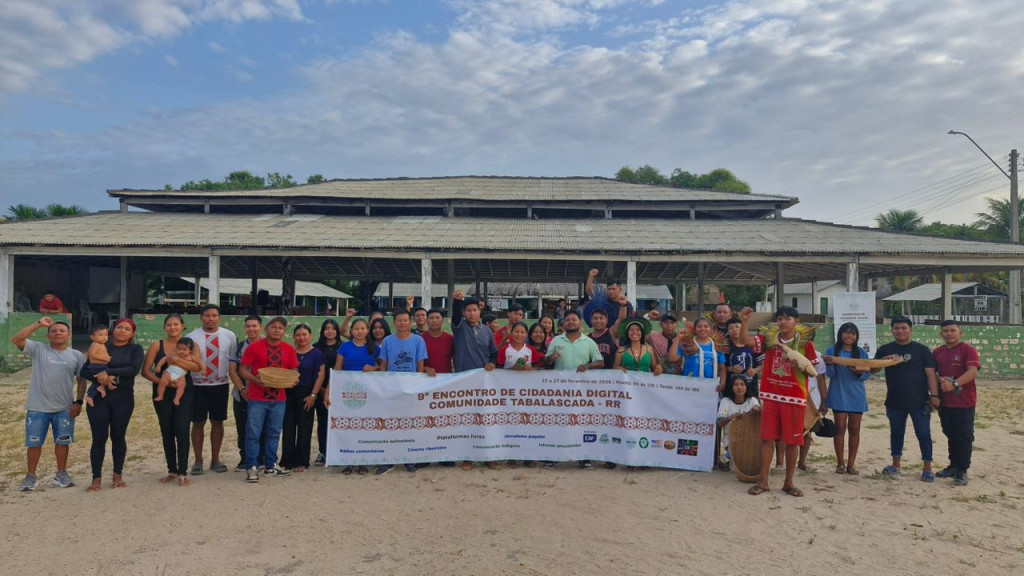
Between February 24 and 27, 2026, the Indigenous Council of Roraima (CIR), through its Department of Communication and the Wakywaa Indigenous Communicators Network, held the 9th Digital Citizenship Meeting, in the Tabalascada indigenous community, T.I. Tabalascada, Serra da Lua region, in partnership with the Terra Preta Project.
The opening was held with traditional songs and dances, maruwai smoking and presentation, by regions, of the communicators present. More than 30 communicators from the Serra da Lua, Raposa, Serras, Tabaio, Alto Cauamé, Alto Miang, Wai Wai, São Marcos, Surumu and Raposa Serra do Sol Indigenous Training and Culture Center - CIFCRSS participate in the meeting, including members of the Wakywaa Network and representatives from different territories. The meeting aims to strengthen indigenous communication as a tool for resistance, territorial defense and cultural affirmation of the indigenous peoples of Roraima.
The Indigenous Council of Roraima was represented by the deputy tuxaua general, Paulo Ricardo, by the coordinator of the Youth Department, Raquel Wapichana, by the Department of Communication, represented by the coordinator Charles Taurepang and by the photojournalist Maciel Macuxi. Also part of the opening table were the coordinators of the Terra Preta Project, Jader Gama, Nayara Kambeba, and Nailson Wapichana, partners in carrying out the training, who contributed with methodologies and experiences aimed at strengthening digital citizenship in the territories.
"This meeting aims to strengthen the network of Wakywaa indigenous communicators, with exchanges of experiences, workshops and, above all, to plant seeds in each of the participants so that they take the knowledge acquired here to the territories and germinate in their communities", said Charles Taurepang.


The CIR has invested in the training of indigenous communicators since the creation of its Department of Communication, strengthening the production of its own content, territorial defense and cultural appreciation in the territories. In 2019, this process was expanded with the creation of the Wakywaa Indigenous Communicators Network, consolidating a permanent strategy of articulation, training and exchange of experiences between young communicators from different regions. Over the years, the network has consolidated itself as one of the main experiences of indigenous communication in Brazil, expanding the presence of indigenous peoples in digital media based on their own narratives. The partnership with the Terra Preta Project adds to this process, contributing to exchanges and methodologies developed in different territories of the Amazon.
Nayara Kambeba, spokesperson for the coordination of the project, points out,"When we talk about Terra Preta and Ajuri, we are talking about ancestral technologies that have always existed in our territories. Terra Preta is indigenous science, built with knowledge accumulated over generations. Ajuri is the practice of collective doing, of working together. By bringing these fundamentals to the concept of Terra Preta Digital, we show that the virtual environment can also be a space for collective construction, for strengthening our narratives and for producing knowledge from our own worldview".
During the days of the workshop, the program was designed to strengthen not only technical skills, but mainly the autonomy in communication of indigenous peoples in the territories. The activities sought to expand the tools already used by the regions, consolidating communication as a strategic instrument for defense, mobilization and cultural affirmation.
One of the highlights was the creation and production of podcasts and videocasts, formats that have been consolidating themselves as important means of dialogue with communities and the external public. The initiative expands the possibilities of circulation of indigenous narratives, allowing the leaders themselves, youth and communicators to produce audio and video content based on their realities, languages and experiences.
Journalist Felipe Medeiros conducted the podcast workshop, and highlighted that:"When we master these tools, we don't depend on others to speak for us, we tell our own story".
Another activity of great relevance was the practical class on handling drones. The training enabled the communicators to learn techniques for operating and capturing aerial images, a resource that strengthens both audiovisual production and the registration and monitoring of territories, contributing to the protection of communities and the documentation of actions developed in the regions.
The drone workshop was given by Maciel Macuxi, photojournalist from the CIR's Communication Department, who reinforced:"You, as communicators, need to know how to handle the equipment so that, when the leaders need support, you are able to follow the monitoring work within the indigenous territories."


In addition to these activities, the participants also had workshops on the production of written materials, layout of websites specific to the regions, video editing and photography, strengthening the technical skills of the communicators who work directly in the territories.
Simone Clarindo, from the Macuxi people, from the Camará community, Baixo Cotingo region, says that she has been in communication for more than 4 years and leaves a message for the new communicators:"I have been working for more than 4 years and, over that time, I have gained a lot of experience and learning. Everything I have learned I have passed on to the new communicators. Currently, a new communicator has been appointed, Elisiane Macuxi, from the Água Fria community, in my region. She is very interested and everything I have learned I have shared. This training was of great importance to us. I also hope that the new communicators never give up, that they get stronger and stronger and that we can continue the work."
Dedson Martins, from the Barata community, Tabaio region, recently joined the Wakywaa Network. Graduated in Information Technology, he has managed the pages of the Tabaio region on social networks. In his first participation in a training promoted by the CIR, he leaves a message for the youth:"It is a great opportunity to be here. The exchanges of experiences, trips and training add a lot of value to the dissemination of our culture and our history. I hope that those who do not yet know the network will come to know our work and add to our struggle."
The 9th Digital Citizenship Meeting reaffirms the CIR's commitment to strengthening indigenous communication as an instrument of autonomy, defense of territories and combating disinformation, consolidating the Wakywaa Network as a permanent strategy for training and articulation of indigenous communicators in Roraima.
Text: Charles Taurepang
Photos: Marcelino Baniwa, Jonildes Macuxi, Gleidson Macuxi, Eduardo Rodrigues (Communicators), Charles Taurepang and Maciel Macuxi (ASCOM/CIR)