
The first hearing of the special commission created by the Supreme Federal Court (STF) to discuss Law 14.701/23, sanctioned in 2023, showed a dubious stance from the Supreme Court at the start of its work. In 2023, the STF itself rejected the temporal framework thesis in the Xokleng case, and today, once again, a discussion that, apparently, had already been overcome, has returned.
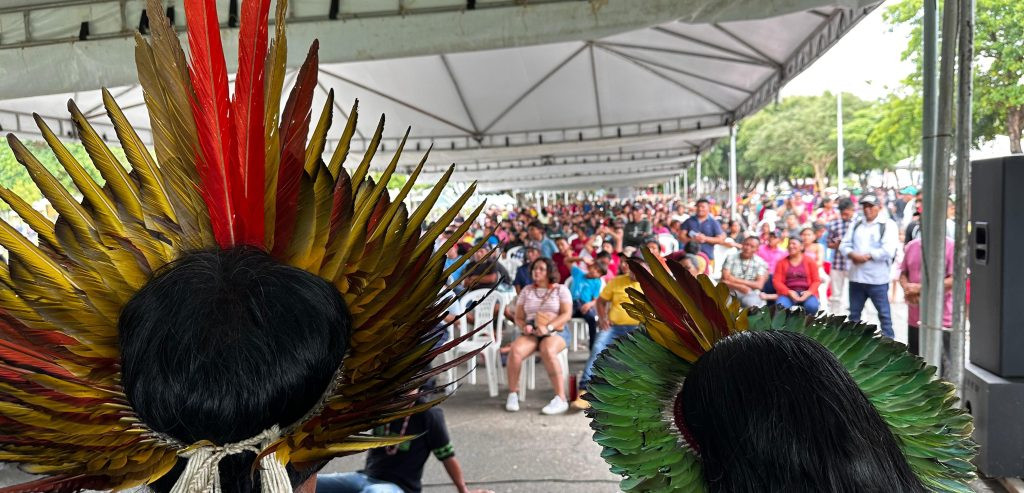
On the third and final day of indigenous mobilization in Roraima, with more than 8,000 indigenous people gathered at Praça Ovelário Tames Macuxi in Boa Vista, indigenous leaders declared that they will not give up their rights, especially their right to territory, an original right, and will also thoroughly evaluate future strategies for struggle and resistance against the temporal framework law, which has been impacting the lives of indigenous peoples.
With Minister Gilmar Mendes at the helm, known for his statements favorable to agribusiness and rural landowners, the composition of the commission is already a factor that proves unfavorable to indigenous peoples. The commission began its work by overriding one of the basic principles guaranteed in the Constitution and in Convention 169 of the International Labour Organization (ILO): free, prior and informed consultation with indigenous peoples.
The legal department team of the Indigenous Council of Roraima (CIR) made a brief assessment of the first conciliation meeting, highlighting the structure of the 23-member composition, with 11 members declaring themselves in favor of the constitutionality of the law, the disadvantage to indigenous peoples in terms of representation at the conciliation table, and the political confrontation at the grassroots level during the election period, with the brazen enticement of parties that defend the temporal framework law, acting blatantly in indigenous communities.
Indigenous lawyer and legal advisor to CIR, Junior Nicacio, assessed that conciliation, instead of helping indigenous peoples, will increasingly harm them. “Indigenous lands will continue to be invaded. Conciliation, instead of helping indigenous peoples, seems to be serving to hinder the demarcation of indigenous lands,” he assessed, pointing out that the indigenous lands of Roraima, currently undergoing demarcation, could be harmed by the temporal framework law.
In light of the mobilization that brings together more than 8,000 indigenous people, the general chief of the CIR, Edinho Batista, when analyzing the legal and political context of Law 14.701, said that there is no doubt about what is happening: a great risk and danger to indigenous rights.
“The Brazilian state, even in the 21st century, attempts to decimate, control, and silence the voice of the people who have legitimate rights. We cannot discuss quality education, health, and sustainability without territory. We are in a political game with large corporations that want to transform our territories into markets. Faced with this, we will not give up our rights, our original rights,” he stated.

Indigenous organizations in Roraima also assessed the situation and called for collective struggle and the strengthening of indigenous peoples to confront yet another attack by Congress and now the Supreme Court, attempting to mediate rights that are non-negotiable.
The coordinator of the Organization of Indigenous Women of Roraima (OMIR), Gabriela Peixoto, from the Surumu region of the Raposa Serra do Sol indigenous territory, when mentioning the attack and violence against the Guarani and Kaiowá indigenous peoples of Mato Grosso do Sul, also recalled the acts of violence against the peoples of Raposa Serra do Sol.
“As a woman, a mother, and a daughter, we feel like our bodies are being destroyed and violated. We are very sad because we are suffering. We have already been through this within the Raposa Serra do Sol Indigenous Territory. We ran in fear of the police, and we are seeing the same thing happening to our relatives in Mato Grosso do Sul. It is very sad,” she lamented, regarding the progress of the temporal framework law and its impacts on the communities.
The law also opens discussion for other actions such as mining on indigenous lands. Mining that is not regulated in these territories, but illegal mining directly impacts territories such as Yanomami and Raposa Serra do Sol.
The director of the Hutukara Yanomami Association (HAY), Remo Yanomami, said that they are also concerned about the time frame. “We Yanomami are very worried about the time frame. Our Yanomami land is being damaged because of the gold miners. Our children, women, and grandmothers are suffering,” he expressed.
The indigenous movement decided to hold further mobilizations as the Commission's work continues.
After five days, since the indigenous delegations arrived in the capital Boa Vista from various regions of the state, the movement concluded with cries of resistance, traditional dances and songs, and the affirmation that they are against the Temporal Framework and that they will not negotiate rights.
Statement of repudiation against the time frame law and the request for its suspension.
Finally, the indigenous movement published a statement of repudiation against Law 14.701, the temporal framework law, and asked the Supreme Federal Court (STF) to suspend the law known as the "law of indigenous genocide".
Note from the Indigenous Movement:
Letter from the Indigenous Movement of Roraima 06/08/2024 (opens in new window)
