
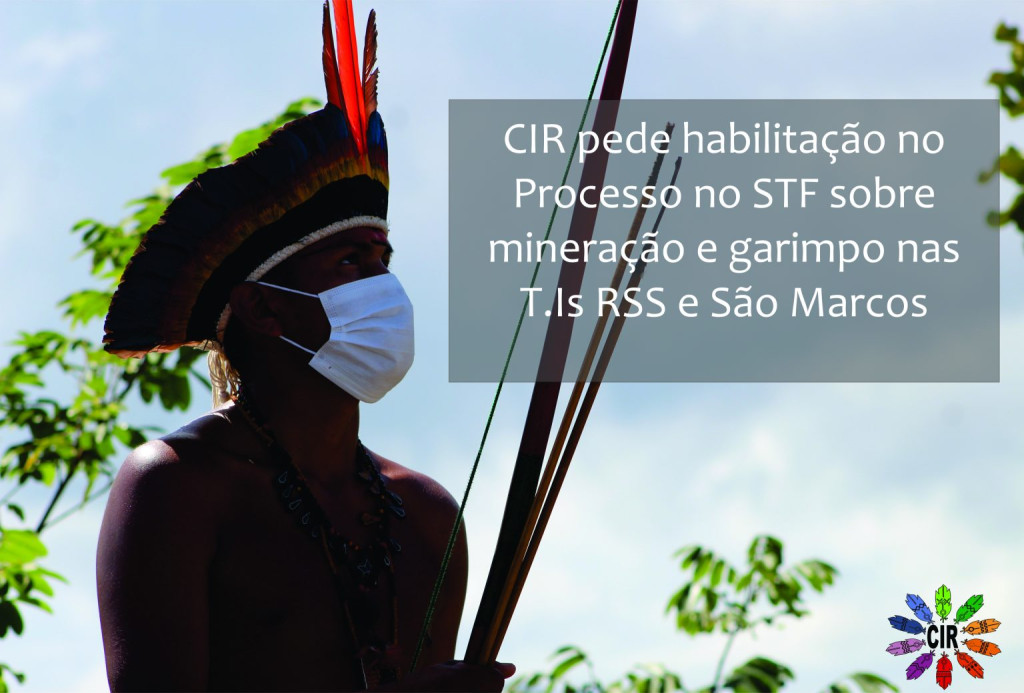
The INDIGENOUS COUNCIL OF RORAIMA – CIR filed a request for qualification as "amicus curiea" in the records of the Writ of Injunction (MI 7.369/DF) filed by the Society for the Defense of the United Indians of Roraima – SODIURR in favor of its members against alleged legislative omission by the National Congress and the President of the Republic in the regulation of the exercise of artisanal mining, by indigenous people, within the Raposa Serra do Sol and São Marcos indigenous lands.
Sodiurr mentions that the absence of a regulatory standard caused, in March 2021, agents of the federal government (Federal Police, Army and Ibama) to destroy houses and work materials of several indigenous people who were practicing artisanal mining.
In the process, the Federal Senate presented information, arguing that there is no legislative rule, ruling out the appropriateness of the writ of injunction. And it argues that, in the case at hand, the plaintiff seeks to remedy the legislative omission of an infra-constitutional rule, that is, article 44 of Law 6,001/1973, which does not authorize the use of the injunction writ, intended exclusively to make up for the omission of the Government in enabling the exercise of rights and freedoms provided for in the Federal Constitution itself. In addition, there is no rule in the Federal Constitution that guarantees the right of indigenous people to promote artisanal mining within their lands. It clarifies that what is ensured by § 3 of article 231 of the Federal Constitution, in fact, is the participation of indigenous people in the results of mining, in accordance with the law.
The CIR argues that it is not feasible to proceed with MI 7.369 and that an inexpressive group of indigenous people is co-trained by criminal organizations of illegal mining on indigenous lands (property of the Union), leading them, unfortunately, to deviate and defy criminal legislation.
The request to enter the process occurs so that according to the legal advisor Dr. Ivo Aureliano, the Council can present the real facts about the case, he explains:
“SODIUR, through a legal tool called a writ of attachment that aims to enforce fundamental rights provided for in the constitution, which need a law or a legal norm to materialize these rights, is known as "a constitutional remedy", provided for in the Constitution and in law thirteen thousand 13.300/2016, and which can be used whenever a total or partial lack of a regulatory norm makes the exercise of constitutional freedom rights unfeasible.
According to the Law, natural or legal persons who hold the rights are entitled to file the writ of injunction.
In this case, Sodiurr claims that there is no law that regulates the activity of mining on indigenous lands by indigenous people. And that this makes the right to work of its indigenous associates unfeasible, and that they would be prevented from carrying out the activity of artisanal mining in the Raposa Serra do Sol and São Marcos indigenous land. Sodiurr says that they have the right to mine, according to article 44 of Law 6001 (Statute of the Indian). And that in the absence of a law, the indigenous people would be suffering from operations by the Federal Police, Army, which is destroying materials, equipment and houses of the indigenous people. We know that this is not true, what is happening is fighting crime within the land of Raposo Serra do Sol and São Marcos.
The Senate has already expressed itself in the process saying that there is no delay in creating a law and that this action is not appropriate, this is not an adequate tool to force the National Congress through the Supreme Court to create a law.
Because this brings to the attention of the STF the reality, that there is no artisanal mining, as Sodiurr says. And that the legal grounds do not ensure mining by the indigenous people themselves. That is why we ask for the unfeasibility of proceeding with MI 7.369 and that an inexpressive group of indigenous people is co-opted by criminal organizations of illegal mining on indigenous lands (property of the Union), leading them, unfortunately, to deviate and defy criminal legislation."
Explained Ivo Aureliano, Legal Advisor of the CIR.