
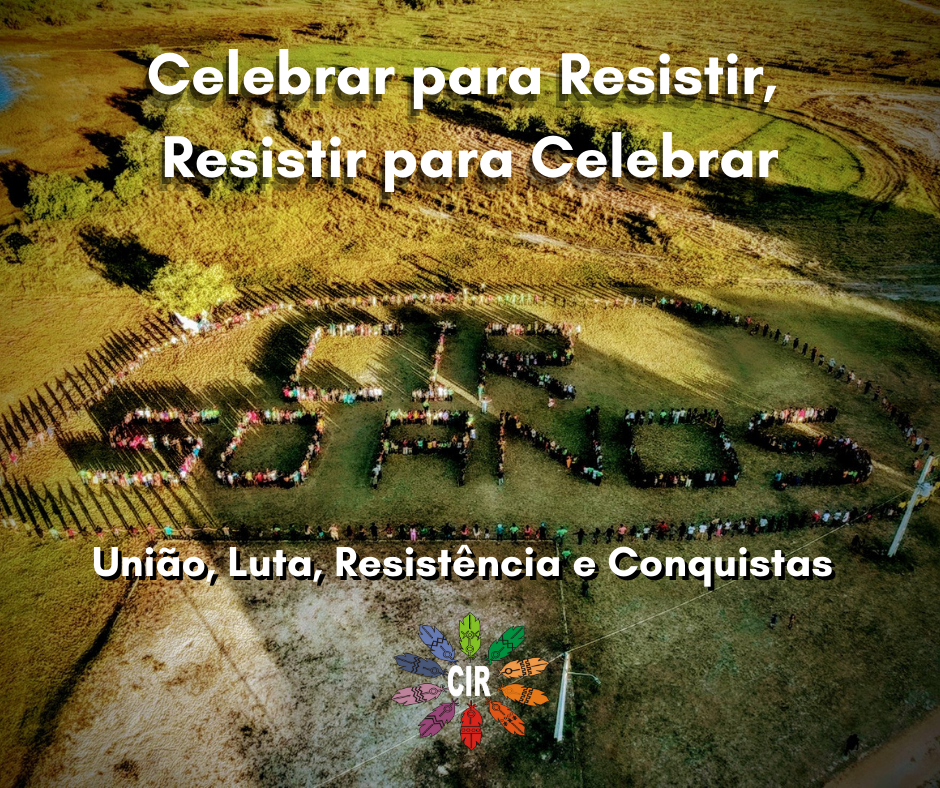
The celebration of the 50th anniversary of the CIR, which was held in January 2023, still has repercussions within the indigenous movement of Roraima. Scheduled for 04 days, from January 16 to 19, at the Lago Caracaranã Regional Center, Raposa Serra do Sol Indigenous Land, the main milestone of the conquest of the indigenous movement of Roraima. The celebration brought leaders from Roraima and Brazil, bringing together 2 to 3 thousand people, from the Macuxi, Wapixana, Taurepang, Ingaricó, Yekuana, Wai Wai Yanomami, Baré, Sapará, Surui and Yanomami peoples, among other peoples and partners.

With an emphasis on the history of the struggle, the traditional tuxauas told the story from the 1970s, when the first Assembly was held in the Surumu Region. What many claim is that the meeting was held at the Raposa Serra do Sol Indigenous Training and Culture Center (CIFCRSS), in the Barro Community. But according to the traditional leader Euclides Pereira, the Assembly was held at the São José Mission in the same region. This was dissolved during the debate of the leaders, precisely by the National Foundation of Indigenous Peoples (FUNAI) and by the army, because the law imposed leniently on the indigenous leaders did not allow them to meet, and the state was responsible for their tutelage, the year was 1971.

Recounting a little of history, from the decades of assemblies, the leaders see that many of their difficulties and violence suffered came in the same way and often from the same mentors, the state, farmers and miners. Since then, there have been 51 assemblies and along with it 52 years of the Indigenous Council of Roraima (CIR), which plans, institutes and complements the indigenous movement. Due to the COVID-19 pandemic, the celebration could not be held in 2019 and 2020.

Within the celebration, all delegations were received along with the smoking with Maruai, by the shaman Mariana and the Tukui dance, celebrating the arrival of visitors, guests and partners. Also on the first day (16), two young women also read the history of the CIR, recalling the struggles and the first coordinations, from Terêncio Luiz da Silva, first general coordinator and Jacir José da Souza, deputy coordinator, both of the Macuxi people from 1989 to 1990, to the current coordinators in the eleventh coordination, this time as executive, with Edinho Batista Macuxi, Enock Taurepang and Maria Betânia Macuxi as Secretary of the Indigenous Women's Movement of the organization.
Joênia Wapichana was received with festivity, because at the time she was about to be appointed the first Indigenous President of Funai, as she had already been after the nomination of the leaders of Roraima, the first Indigenous woman in the state to take a seat in the federal chamber of deputies in Brasília.
The coordinators from 1989 to 2023 carried out a succinct and thorough evaluation and told a brief history of their administrations. Highlighting the struggles and maneuvers to conquer spaces in the state that increasingly oppressed and sought to saturate the struggle with hate speech, even by parliamentarians from the 1990s and the current ones. The young people present reaffirmed that the struggle does not end with demarcations or homologations, but with resistance and insistence. And they also paid tribute to the leaders who over time were killed by the invaders. With a special tribute to the three deceased CIR coordinators, among them Dionito José de Souza, a reference in the struggle for the Raposa Serra do Sol Indigenous Land and a staunch defender of indigenous education and health.

Those who are still on the front line in the indigenous movement were honored, such as Clovis Ambrósio from the Serra da Lua region, Jacir José de Souza, T.I Raposa Serra do Sol, Terêncio Macuxi, T.I Raposa Serra do Sol, Noberto Cruz, Serra da Lua, Lavinia Macuxi, Serras region, among others who are part of the tireless indigenous movement. On the occasion, the documentary "CIR 50 Years" produced by the CIR Communication department, with the support of Coletivo 105, NCI and IEB, was shown on the cultural night.
The Order of Coordination of the Indigenous Council of Roraima:
1st Coordination – 1989 to 1990 General Coordinator – Terêncio Luiz Silva – Macuxi – Surumú Region Vice-Coordinator – Jacir José de Souza – Macuxi – Serras Region
2nd Coordination – 1990 to 1992 General Coordinator – Clóvis Ambrósio – Wapichana – Serra da Lua Region Vice-Coordinator – Valdir Tobias
3rd Coordination – 1993 to 1994 General Coordinator – Euclides Pereira – Macuxi – Surumú Region Vice-Coordinator – Clóvis Ambrósio – Wapichana – Serra da Lua Region
4th Coordination – 1995 to 1996 General Coordinator – Nelino Galé – Macuxi – Baixo Cotingo Region Vice-Coordinator – José Adalberto – Macuxi
5th Coordination – 1997 to 2000 General Coordinator – Jerônimo Pereira – Macuxi – Tabaio Region Vice-Coordinator – Desmano de Souza – Macuxi – Raposa Region
6th Coordination – 2001 to 2005 – two terms General Coordinator – Jacir José de Souza – Macuxi – Serras Region Vice-Coordinator – Noberto Cruz – Wapichana – Serra da Lua Region Secretary – Lavínia Macuxi – Serras Region
7th Coordination – 2005 to 2006 General Coordinator – Marinaldo Trajano – Macuxi – Baixo Cotingo Region Vice-Coordinator – Jairo da Silva – Macuxi – Murupú Region. Secretária_ Luciana Lima Pinto – Macuxi – Baixo Cotingo
8th Coordination – 2007 to 2009 General Coordinator – Dionito José de Souza – Macuxi – Serras Region Vice-Coordinator – Terêncio Salomão – Wapichana – Serra da Lua Region Secretary-Marizete de Souza – Macuxi – Serras Region
9th Coordination – 2011 to 2017 – three terms General Coordinator – Mário Nicácio – Wapichana – Serra da Lua region Vice-Coordinator – Ivaldo André – Macuxi – Serras region Secretary-Telma Marques- Taurepang- Amajarí region
10th Coordination – 2017 to 2019 General Coordinator – Enock Tenente – Taurepang – Amajarí Region Vice-Coordinator – Edinho Batista – Macuxi – Serras Region Secretary – Maria Bethânia Mota de Jesus – Macuxi – Amajarí Region
11th Coordination – 2021 – term in force General Coordinator – Edinho Batista – Macuxi – Serras region Vice-coordinator – Enock Tenente – Taurepang – Amajarí region Secretary – Maria Bethânia Mota de Jesus – Macuxi – Amajarí region.

The presence of indigenous leaders at the national level was also one of the great milestones of the Celebration. Alcebias Constantino, from the Sapará people / Coordination of Indigenous Organizations of the Brazilian Amazon – COIAB, Toya Manchinere / COIAB, Beto Marubo / UNIVAJA, Darcyr Marubo / Alliance of Indigenous and Afro-descendant Peoples of Nicaragua – APIAN, Almir Surui, Marivelton Baré / Federation of Indigenous Organizations of the Rio Negro – FOIRN, as well as representatives and partners of the Indigenous Missionary Council – CIMI, Federal University of Roraima, Socioenvironmental Institute, UNICEF, Institute of International Education of Brazil – IEB, FORD FOUNDATION, USAID, NIATERIO, Amazon Cooperation Network, Amazon Environmental Research Institute, CAFOD and Nature Culture International – NCI among other collaborators and supporters of the indigenous cause.

According to the Deputy Coordinator of the CIR, Enock Taurepang, the celebration is not only to celebrate, but to carry out a self-criticism as an indigenous movement of what has been achieved so far. "What do we continue to maintain as a fortress? Where did we go wrong on this journey? These days that have passed have been of analysis, where we talk, we tell stories, just as the CIR was born, we relive this in the days that have passed, our leaders at the beginning came to tell the story to their grandchildren, children, relatives, we are reliving the creation of our movement, because that is how it began. As they mention, there were not many plans, they met to listen to each other and so we reflected on this history. So, in the next 50 years, what we want is that the youth, father and mother of families can dream of a prosperous life, of good living, and that this dream can come true within the communities and in indigenous territories", he said. "When they (leaders) stop walking, talking and listening, we will be, their strength, voice, ears and walk. As long as our creator allows us to fight, we will be here for our territories in a harmonious and loving way with mother earth.", concluded Taurepang.
Almir Surui, leader of the Surui people of Rondônia, stressed the importance of the privilege and the honor of being invited. "For me it is a great reflection of the indigenous movement and the indigenous peoples of Roraima for this struggle and challenges they have faced during these 50 years. We have learned great things, because all achievements have a path to follow with strategies. The CIR is an example as an organization, which shows that the existence of the rights of the peoples must be respected by institutions and society, by the world that does not know who these peoples are who contribute to the common good of humanity, indigenous peoples." Said Amir Surui.
Lawyer Paulo Machado Guimarães said that the organization is the proud and combative expression of the indigenous peoples of Brazil. "There is no indigenous organization with the dedication, commitment and mobilization of the peoples and their leaders, for a period as long as the CIR, in a structured, dedicated way, with its own political formulation, with the aggregation of all the peoples of Roraima in a systematic and consequent way in the organization and a project of struggle according to their interests. I have the privilege of following the struggle of the CIR, of two leaders since 1983, when it was still a federal territory, at a time of reaffirmation of the peoples, where they were persecuted and imprisoned. It was in this context that together with colleagues from the Indigenous Missionary Council of the North – CIMI, who sought to file habeas corps to the peoples of Roraima, and that at the time the judges themselves saw a true campaign of persecution, and responded to the requests. I am a fan of the indigenous leaders of Roraima, I consider it the most solid and important, regional and local organization in the country, without taking away the merit of other organizations from other states." Said the lawyer.
Mayra Wapichana, was the first indigenous journalist in the CIR and acted as an advisor to Joenia Wapichana, while acting as a Federal Deputy for Roraima, for her it is a satisfaction, being able to experience and learn even more about what the 50 years of the CIR have been. "Among the many achievements are that of indigenous communication, as it is also part of this trajectory of struggle for decades in which leaders already had their means of communication, interaction, strategies for articulation and organization and strengthening of this struggle. Indigenous communication came to strengthen and aggregate, where I am also part of this history as a journalist working for the CIR and also expanding this training through indigenous communicators and other professionals who leave the university. And today seeing the Wakywai Communicators Network acting in this space and recording this memory is part of this trajectory." Mayra said.
The celebration had the exhibition of organic products from indigenous communities, being marked by the appreciation of culture, art and traditional songs, and the planting of two trees that are symbols of the struggle and trajectory of the indigenous movement. Another important point was the realization of symbolic acts in favor of the Yanomami peoples, with the formation of SOS in favor of the aid campaign and the immediate removal of miners from the territory.