
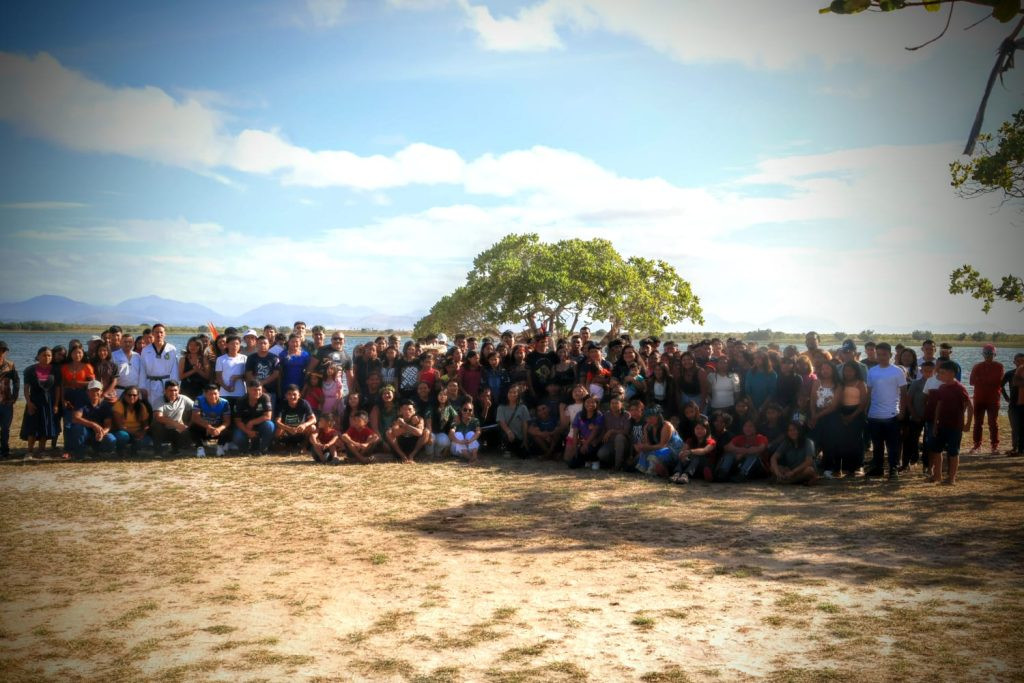
The 5th Indigenous Music and Arts Workshop was held between February 13th and 16th at the Lago Caracaranã Regional Center, Raposa region, Raposa Serra do Sol Indigenous Territory, municipality of Normandia.
Approximately 200 young people from the Raposa, Baixo Cotingo, and Serra da Lua regions participated in the activities. The sharing of knowledge involved workshops on indigenous graphic art using jenipapo fruit, visual painting of indigenous arts, production of handicrafts with fibers, seeds, beads, slings, cotton hammocks, singing, guitar, and sound engineering workshops, in addition to taekwondo and capoeira workshops.

In the workshop on strengthening indigenous graphic arts as protection and ancestral spiritual medicine using genipap, participants paid close attention to the production of the ink and the guidance of teachers Bruna Macuxi and Daya Roraima."The liquid can become thin, in which case some indigenous peoples use charcoal to make it more consistent. The stalks for making the paintings can be easily found in nature; here we have coconut stalks. They should be both thick and thin to complete the graphic design," the teachers stated.
In the other workshops as well, such as the one on visual painting of indigenous arts on fabrics and canvases, the instructors were all indigenous. Vinicius Kenede, from the Macuxi people, a resident of the Raposa I indigenous community, was one of them. He highlighted the importance of passing on knowledge to other young people, citing the artivist Jaider Esbell as an inspiration.

"I received an invitation to be an instructor in the workshop, and being here is an important way to rescue and preserve our stories, landscapes, and our way of seeing our world,""I started painting on canvas in 2015, inspired by Jaider Esbell, who introduced me to canvas painting and acrylic paint, and from then on my art began to gain color," explained the artist.
Young Rivas Macuxi, who participated in the workshop for the second time (he was a student in the fourth edition and is now an instructor), emphasized that youth participation is fundamental to learning about and valuing indigenous culture.
“It is very important to bring young people here so that they hear and talk more and more about our culture, not only in schools or communities, but everywhere, sharing what we have best to offer, such as our handicrafts,” Macuxi pointed out.
Planned in 2017 by the youth coordination of the Raposa region to strengthen indigenous culture, the dream came to fruition in 2018. However, due to the COVID-19 pandemic, it was put on hold for a while, returning in full force in previous years with the great participation of young people from other regions, as explained by law student Carla Jarraira, who has been coordinating the workshop since its first edition.
"The workshop strengthens our culture, allowing young people to learn and pass on knowledge to others, as has always been the case since the beginning. The fifth workshop introduced the production of cotton hammocks, capoeira, and taekwondo workshops, noting that all instructors are indigenous and non-indigenous volunteers," Jarraira pointed out.

The outstanding students from the fifth edition will participate in an exchange program and present their work at the Museum of Contemporary Art in the state of São Paulo, with the support of the Pro-Rector for Inclusion and Belonging at the University of São Paulo (USP), as explained by Reinaldo Oliveira, who is part of the workshop's organizing committee and a doctoral student in social anthropology at the institution.
“The support for this came through the “Our Culture” project, aimed at young people, which I and another colleague wrote through the call for proposals available at the university's Pro-Rectorate for Inclusion and Belonging. Those selected will go to São Paulo to participate in a meeting of two peoples with Carib linguistic roots, with the Kurâ Bakairi people from Mato Grosso. It will be a very important exchange of knowledge for everyone.”Oliveira concluded.
The techniques and products created during the workshops were displayed on the last day of the program.
The event was held with the support of the Youth Department of the Indigenous Council of Roraima, communities in the Raposa region, volunteer instructors, and the municipality of Normandia..