
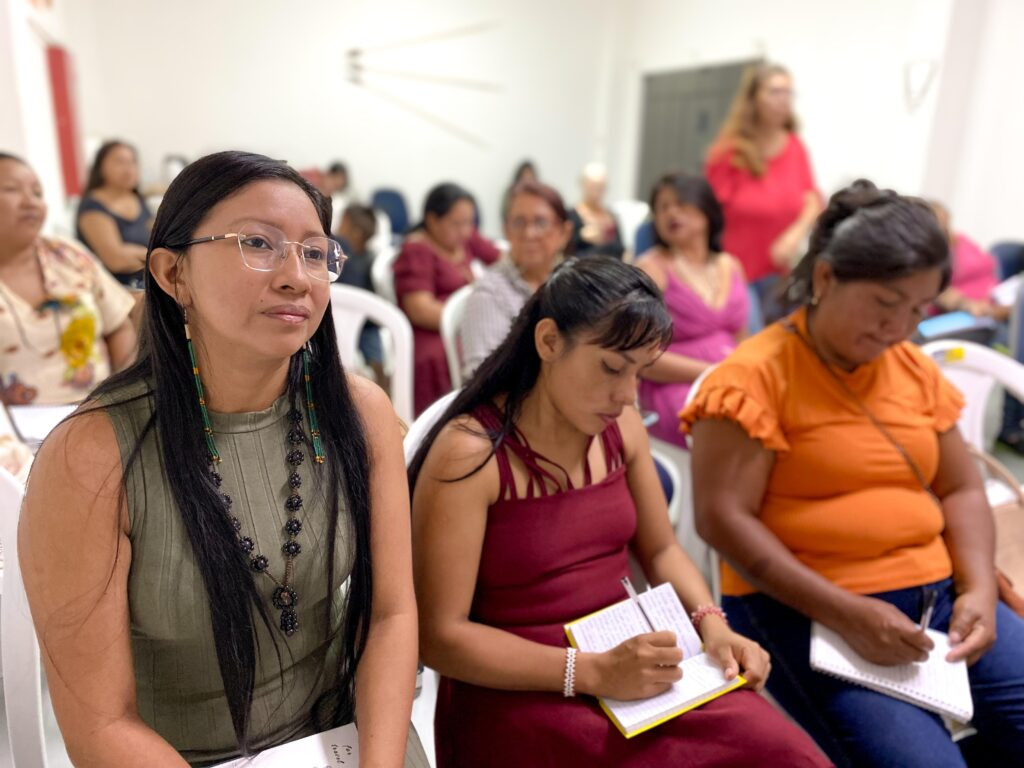
Following the sequence of agendas of the General Tuxaua of the Indigenous Women's Movement Kelliane Wapichana and regional tuxauas, last Saturday (06), representatives of the Indigenous Council of Roraima (CIR) participated in a meeting on public policies for indigenous women, with the presence of the National Foundation of Indigenous Peoples (FUNAI/RR), Ministry of Agrarian Development and Family Agriculture (MDA), Ministry of Culture (MINC) and EMBRAPA.
The objective of the meeting was to promote dialogue between indigenous women and government agencies, aiming at female leadership, empowerment, and the preservation of traditional cultures and productions.
Chief Kelliane highlighted the importance of listening to and consulting the grassroots before implementing any project in their territories, and emphasized...

“There are communities that have their own seeds, so why introduce another seed model? One thing you should know is that seeds are something already cultivated within the communities. We really want to explore the possibility of these projects, but we have to have this perspective, this care for indigenous production.”
“In the context of the MDA, the goal is to empower Indigenous women to become increasingly central figures in their own spaces, allowing them to choose who they want to work with, whether it be through culture, crafts, dance, or their own production, so that they have access to all territorial policies,” explained Luciana Uchoa, representative of the MDA.
One of the most discussed topics was the lack of information about calls for proposals and development opportunities, which often do not reach indigenous communities.
“It has been many years since we've seen this open dialogue, this exchange of information, because what our communities lack most is information. Only we know where our needs lie. Our wish is that what was discussed here reaches our regions because this training is very important,” observed Aldenicia Cadete, Regional Coordinator of Women of Serra da Lua.

The leaders demonstrated great commitment, sharing their knowledge and always emphasizing the importance of direct dialogue with indigenous communities so that they can understand public policies. This was highlighted by Gabriela Nascimento, State Coordinator of OMIRR.
"There's so much history, so much for you to learn. We get emotional because talking about Indigenous women is like this; we have to empower these women, reach out to them so they can learn about these policies."

During the meeting, a proposal arose to hold a future meeting exclusively for indigenous women, further strengthening their protagonism and empowerment, and Marizete Macuxi, Regional Coordinator of FUNAI, has already offered to contribute.
“We need to look ahead, see how we will support these initiatives in 2025. I've already started to imagine this meeting, I can already see many women gathered there with their products, FUNAI is available to support the realization of this great meeting.”

Furthermore, one of the recurring themes in the discussions, promoted by the representative of the women's department, Tuxaua Kelliane, has been violence against women in indigenous territories, as reinforced by the pajé Vanda Macuxi.
“We’ve been talking a lot about violence against women, and it’s still happening, so we need to organize ourselves to fight against it as well. This is very important for us too; it’s been happening a lot in other states as well, but it’s been growing a lot here, so we need to include women here too.”
In conclusion, the regional coordinator of FUNAI stated that women need training and that their voices need to be heard so that their dreams can truly become reality.