
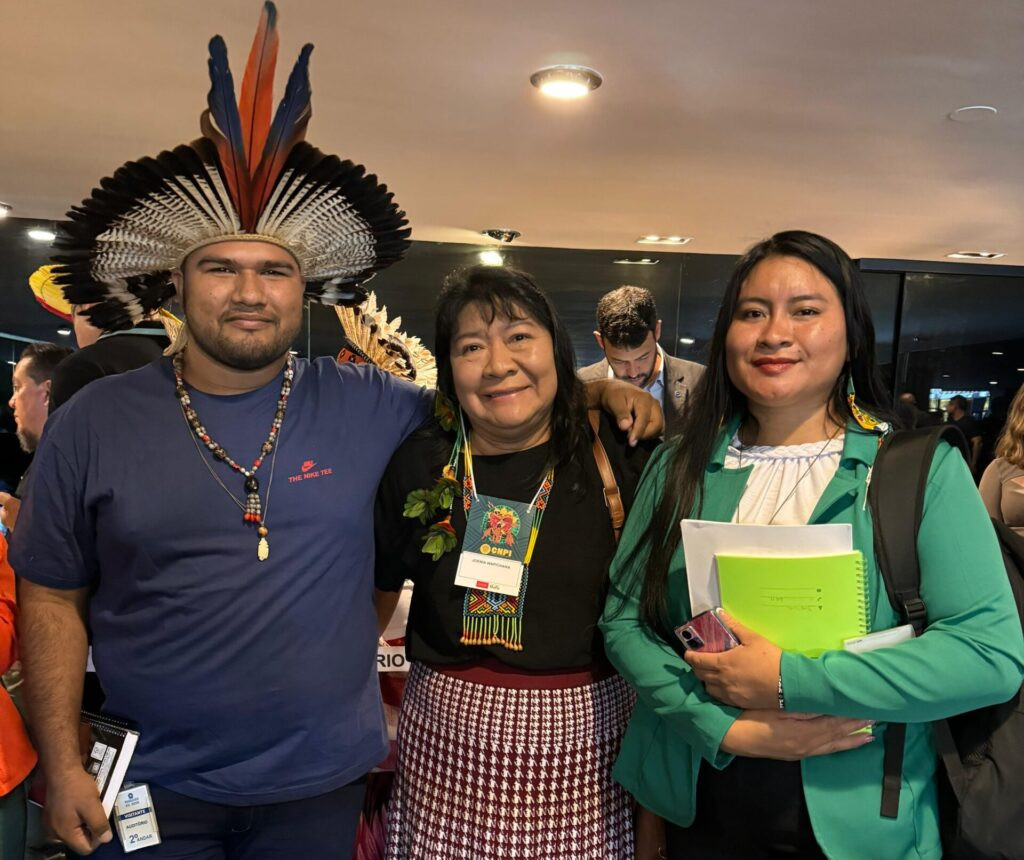
Two young indigenous people from Roraima, Carla Jarraira, from the Macuxi people, and Lucas Wei, from the Wapichana people, representatives of the Indigenous Council of Roraima (CIR), took office as members of the National Council for Indigenous Policy (CNPI), linked to the Ministry of Indigenous Peoples (MPI). The ceremony took place on Wednesday (17), at the Palace of Justice, in Brasilia.
The inauguration, held during the 1st Ordinary Meeting of the CNPI, was also marked by the reinstallation of the Council, extinct since 2019. After the dismantling in the country, the expectation is for the resumption of the indigenous policy, led by the indigenous people themselves.
The inauguration was attended by the Minister of Indigenous Peoples, Sônia Guajajara, the president of the National Foundation of Indigenous Peoples (Funai), Joenia Wapichana, the Secretary of Indigenous Health (Sesai), Weibe Tapeba, as well as indigenous organizations and other government representatives.
Carla and Lucas, appointed at the 52nd General Assembly of the Indigenous Peoples of Roraima, sworn in, carry with them the commitment, responsibility and legitimacy of representing the indigenous peoples of Roraima, in the space of debate, construction and deliberations regarding indigenous policy.
As a full member, Carla Jarraira highlights the indigenous participation in the construction of strategic plans. "It is essential that we have this participation with this voice and this vote, in the construction of strategic plans for the management of our territories", she highlighted.

A law student and intern in the Legal Department of the Indigenous Council of Roraima (CIR), Carla is also one of the references of the indigenous youth of Roraima. For her, it is an honor to take over a space for which the leaders have fought so hard.
"I am honored to be one of the nominees to compose the Council. This shows that our leaders are giving us the opportunity to continue the fight. They have been fighting for this space for a long time and here we are, to bring their voice to the federal agencies", said Jarraira.

The representation of young people is equal, Lucas, as an alternate, also stressed the importance of youth in these spaces, a space for debating public policies aimed at the grassroots. Currently, the young man works as a political advisor at the CIR.
"Today was a very important moment for us, indigenous peoples, and us, youth, who are indications from our bases and leaders to take this fight as well. It was the inauguration at the CNPI, an important tool to bring public policies to our bases," Wei stressed.
In the first meeting, they discuss the internal regulations, the thematic chambers that will guide the work in the next four years (2024-2027), as well as the choices of the members of the government, who will monitor the next activities.
"So this is how we will be meeting the expectations that were entrusted to us, the expectations of our leaders who fought so hard for this space that we are occupying today," said Lucas.
On these days, the 17th and 18th, the members deliberate on the creation of six Technical Chambers: territoriality, protection and territorial management; self-determination, social participation and the right to consultation; indigenous health/school education and indigenous culture; right to memory and truth; social and economic rights.
The approval of the internal regulations will also be discussed, as well as the signing of Official Acts of the MPI with the presence of the President of the Republic, Luiz Inácio Lula da Silva.
CNPI – linked to the MPI, the CNPI is responsible for the preparation and monitoring of public policies aimed at indigenous peoples. The group is composed of 64 full councilors, 30 representatives of the Executive Branch, 30 representatives of indigenous peoples and organizations, and four representatives of indigenous entities, with representatives from all states.
History of creation - The Council was created in 2015 by Decree No. 8,593 by President Dilma Rousseff. However, it was extinguished in 2019, in the first year of the previous government.
With the current government, a new decree signed by President Luiz Inácio Lula da Silva No. 11,509, published on April 28, 2023, reinstalled the CNPI, with the main attribution of monitoring and implementing indigenous policies in Brazil.
