
In the year of the United Nations Conference on Climate Change in Brazil, COP 30, a global event that will be held in Belém (PA), in November, the International Forum of Indigenous Peoples on Climate Change, the Indigenous Caucus, will be co-chaired by the indigenous leader and coordinator of the Department of Territorial, Environmental Management and Climate Change (DGTAMC) of the Indigenous Council of Roraima (CIR), Sineia Bezerra do Vale, from the Wapichana people. This achievement is a historic moment for the indigenous peoples of Roraima and Brazil, having once again, after Joenia Wapichana, the co-presidency of an important and strategic instance such as the Indigenous Caucus.
It will also be a unique moment to present to global society the traditional practices of indigenous peoples, the main guardians of the planet, used in the fight against climate change.
In this sense, the indigenous peoples of Roraima are at the top of the references and global incidence, with the main instruments being the plans to combat climate change built by the indigenous communities, with the coordination of the CIR and support from partners.
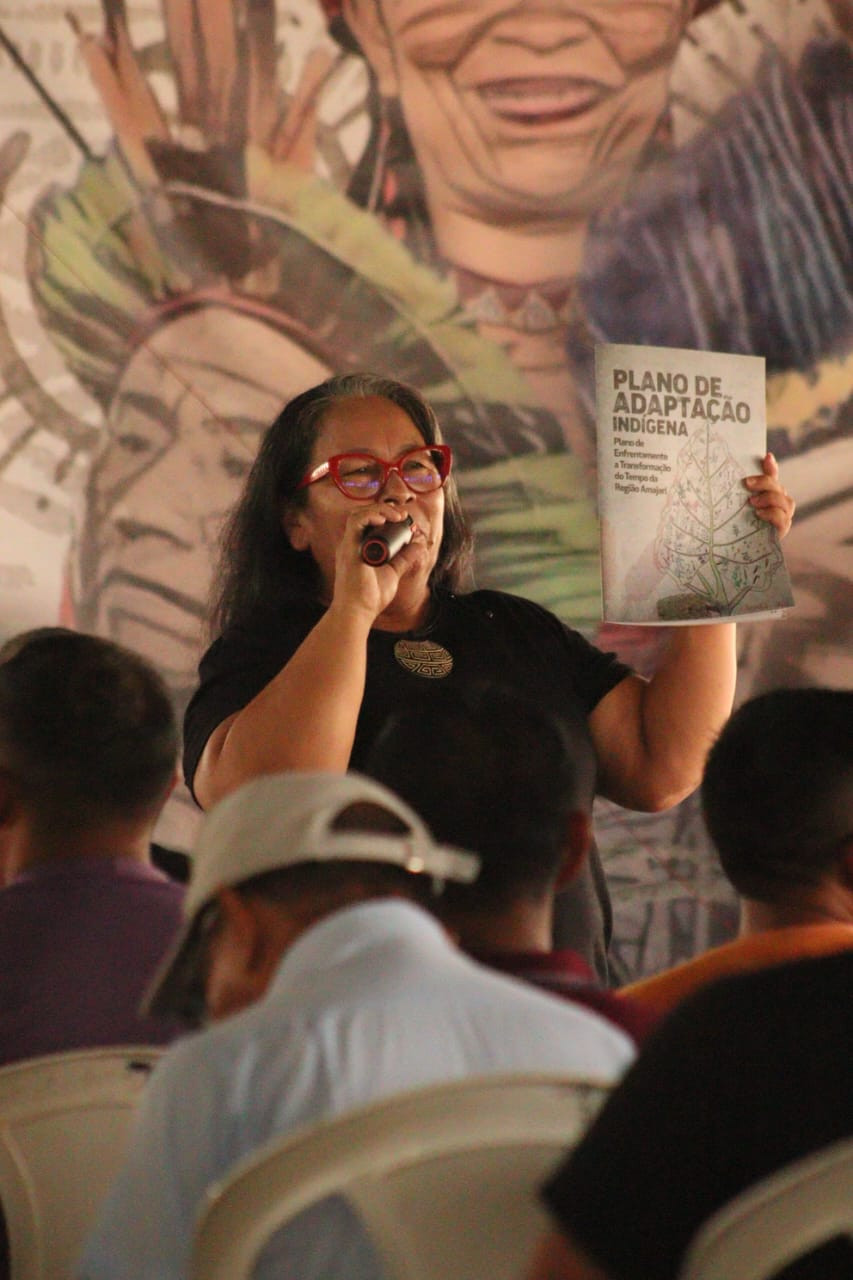
To compose the editions of plans, two more were launched by the DGTAMC of the CIR and the indigenous communities, during the 54th General Assembly of the Indigenous Peoples of Roraima. They were the Indigenous Adaptation Plans of the following regions and indigenous lands: Plan to Confront the Transformation of Time in the Amajari Region and the Raposa Serra do Sol Indigenous Land.

The first Plan to Combat Climate Change was from the Serra da Lua region "Amazad Pana ́adinhan - Perceptions of Indigenous Communities on Climate Change", launched in 2015. Since then, it has been one of the main references at the national and global levels in discussions on indigenous peoples and climate change.
The plan for the Amajari region includes 8 indigenous lands, 20 communities and a population of approximately 4 thousand indigenous people. The Raposa Serra do Sol Indigenous Land, one of the largest indigenous lands in Brazil, with 1.743 million hectares, comprises the municipalities of Normandia, Pacaraima and Uiramutã. Bordering Venezuela and Guyana, the Indigenous Land is divided into 4 regions: Raposa, Serras, Surumu and Baixo Cotingo.
According to data from the Eastern District of Roraima in 2024, the indigenous population of Raposa Serra do Sol reaches more than 33 thousand indigenous people.
Both plans were carried out by Territorial and Environmental Agents (ATAIs) from each region, respecting the perceptions and perspectives of the Communities, focusing on the relationship between indigenous peoples and the transformation of time in different cultural and environmental contexts.

"The work we did on adaptation to climate change was done by looking at what happened from twenty years ago to today. What has changed over time? What are the changes that we have seen that have happened during these twenty years? So, the work we did was through interviews with the elders, asking what they had seen, what had changed for them in the indigenous communities. Then, each ATAI in our region was in charge of doing the research in three communities, others with the larger communities," said Francilene Campino, from the Taurepang people, coordinator of ATAIs in the Araçá community, Amajari region.
According to the coordinator of the DGTAMC, Sineia do Vale, from the Wapichana people, the CIR has produced plans to combat climate change, and brings the experience of indigenous peoples who have made a perception of how time has changed and how this has directly impacted indigenous communities.
"So, all this learning, all these plans, are within these plans that we are launching. We launched the first, in 2015, which was in the Serra da Lua region. We are launching, in 2025, the plan to combat climate change in the Raposa Serra do Sol indigenous land, one of the most emblematic indigenous lands in Brazil. Launching now at this time also in the Amajari region", explains Sineia.
And also according to Sineia, the Plans to Confront the Transformation of Time is one of the most relevant topics to take to COP30 that will take place in Brazil, is the adaptation of this plan. "To get to this discussion at COP30, in addition to climate financing, we are taking to this COP the mechanisms built by the indigenous peoples of Roraima, the indigenous adaptation plan or the plan to combat climate change. Because we know that the government's action agenda is forest and indigenous peoples. So we are presenting it as a tool for discussion and also for the implementation of indigenous adaptation plans during COP30",
History
Since 2015, the plans began to be developed. The first was for the communities in the Serra da Lua region, which is located between the municipalities of Cantá and Bonfim, being an international highlight for its pioneering spirit, and the creation of the plans carried out in the Raposa Serra do Sol Indigenous Land, which began in 2019, and in the Amajari region, in 2023.
The Amajari region is made up of 8 indigenous lands where 20 indigenous communities live and a population of approximately 4 thousand people.
The Raposa Serra do Sol Indigenous Land, on the other hand, is one of the largest indigenous lands in Brazil, with 1,743,089 hectares and 1,000 kilometers in perimeter and is located in the state of Roraima, in the municipalities of Normandia, Pacaraima and Uiramutã, between the Tacutu, Maú, Surumu, Miang rivers, on the border with Venezuela and Guyana. The Indigenous Land is divided into 4 regions: Raposa, Serras, Surumu and Baixo Cotingo, and in 2019 together they had a population of 26,048 people and more than 150 communities coordinated by the CIR.