
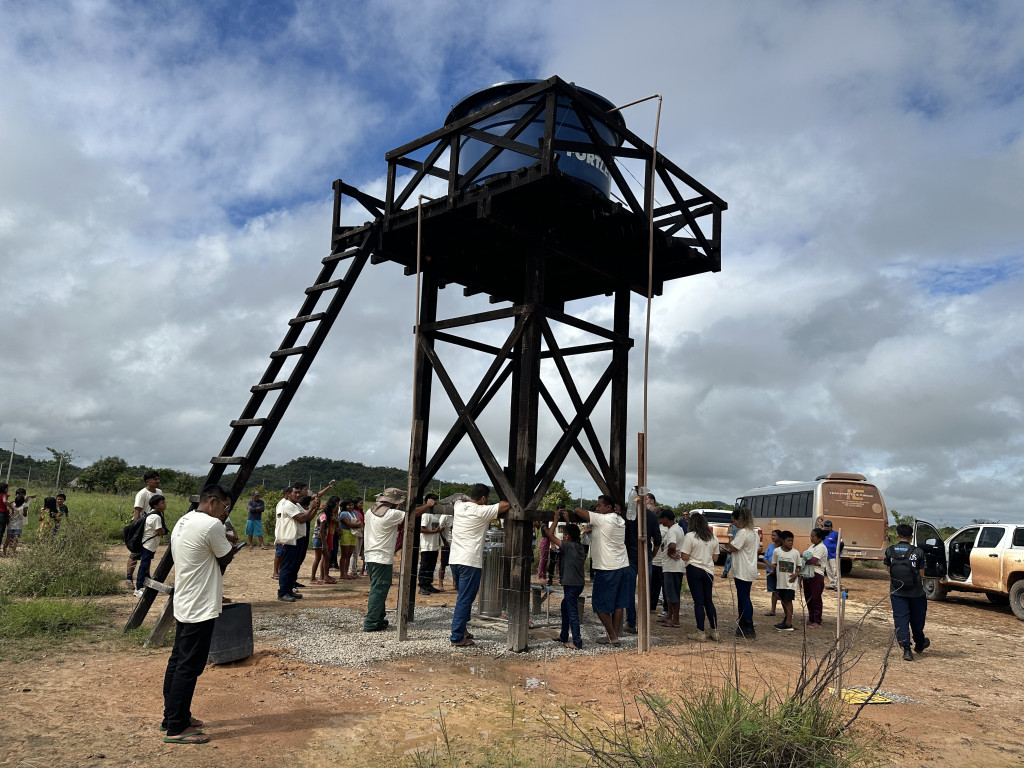
Supported by CAFOD, the project brings drinking water to regions with scarcity of such a precious asset
A dream that made it a reality for about fifty indigenous communities in Roraima, contemplated with actions of the "Water Project", developed by the Indigenous Council of Roraima (CIR), through the Department of Territorial, Environmental and (DGTAMC), coordinated by Sineia do Vale, and with support from CAFOD (Catholic Agency for Development Overseas) and partners such as UNICEF (United Nations Fund for the Environment) Childhood) and Special Indigenous Sanitary District (DSEI LESTE/RR).
Baixo Cotingo and Amajari, are part of the regions of the state with difficulties to have appropriate water for human consumption. For some communities in these regions, the harsh situation changed due to the "Water Project". The partnership between CIR and CAFOD, which exists for more than 20 years it has been instrumental in strengthening autonomy and improving the quality of life and promoting good living in indigenous communities in Roraima.


The lack of water it is not a problem that affects only the Amajari region, the other regions and lands indigenous people in Roraima also suffer from water scarcity. In Baixo Cotingo, municipality of Normandy, the situation is no different from the essential good for the human survival is needed by families. The situation worsens in the period of summer, a time when rivers and streams dry up, drastically affecting daily life of the indigenous communities of the region.
The consumption of Inappropriate water (gasoline-colored) from an artesian well during the dry season took people to get sick, with vomiting, fever and diarrhea. The case was remembered by Janilson de Lima, according to tuxaua of the Itacutú indigenous community, pole – São Paulo base Francisco, Baixo Cotingo region, Raposa Serra do Sol indigenous land, during a visit to monitor how the community was after the implementation of the water supply system in 2023.
"The initiative brought changes in the reality of residents who previously faced difficulties in accessing water, before the project the water used was from the well artesian, but it was not good, it was gasoline colored and caused many diseases," said the leader.
In 2025, for alleviating the situation in the region, five indigenous communities were contemplated, in Serrinha, for example, a well was drilled, an old demand of the community.
In the communities Banco and Wixi, the implementation of the Project, was the collection of water from the River Cotingo. To install the system, it was necessary to carry out heavy metal analysis of the river water, to find out if it was suitable for human consumption.
For the first time since the Indigenous Council of Roraima (CIR) works with this type of system.
In the community Perdiz, the revitalization of the Amazon well, existing in the community. The current structure had a lid, a submerged bimba and a castle of woods.
The action involved the technical team of the DGTAMC and DSEI LESTE/RR, which have been evaluating the area since the for the installation of the well and the solar panel, with the support of CAFOD (Catholic Agency for Overseas Development) and UNICEF (United Nations Fund for the Childhood)
How it works the "Water Project"
The demand comes of indigenous regions and communities, based on this, an evaluation of the demand presented, meeting with implementing partners, then planning of actions. If it is the drilling of the well, support is requested with geologist, to do all the study in the community. It has already happened that the result was negative (unable to drill into the ground) as was the case with the community Bank.
If approved, it is the company's request procedure to perform the service is done. All the wells drilled by the Indigenous Council of Roraima follow the standard of the Special Indigenous Sanitary District (DSEI LESTE/RR).
The castles of wood, which supports a 5,000-liter box, also goes through approval, all the material to raise the structures are purchased according to the guidance of SESANI (Indigenous Environmental Building and Sanitation Service), which made available to the CIR in July 2024 the project of the castle model.


Fátima André, from Macuxi people, is part of the technical team of the Department of Territorial Management, Environment and Climate Change (DGTAMC), Fátima accompanies the project, with water diagnostic visits in the communities, listening to the leaders and seeing the reality of those who need water to live.
"When I started to follow the Water and visiting the communities, I saw that the situation in several places was very critical. Both in summer and winter. In winter, if there is plenty of water, it is not suitable for human consumption, has no adequate treatment. During the summer, it dries up the water sources, it dries up the wells that the community itself makes," he explained Fatima
The challenges increased with climate change, with short rains and long summers, Keeping up with the transformation of time requires wisdom, and the project has helped to families not to lose traditional seeds and to ensure the planting and Abundant harvest.
"We do the actions with the support of CAFOD and other partners, each one has an important role in the execution of the project, and it is gratifying to see the residents of the communities happy, receiving the water system at home, having water access to water is having health, it is if Preventing diseases is ensuring healthy food for all", he concluded Fatima.
The Waters Project, It is also developed with drilling and well cleaning activities artesian, clay filter delivery, water treatment, construction of wooden castle.
In 2026, the Water Project, will support the Serra da Lua region, the activity will start with the diagnosis to raise the demands of the 3 communities in the region that will receive the support due. The initiative will strengthen the autonomy of the Macuxi peoples and Wapichana who live in the region.
Practices Healthy and water preservation
With a focus on to bring information to indigenous communities about water preservation, water supply systems and promote appropriate practices of care for water intended for human consumption, a workshop with the theme "Water and Health" was held in the Indigenous Community Perdiz, Teso do Gavião base pole, Baixo Cotingo region, with the participation of residents of the Ananás Indigenous Community, Amajari region.
Through conversation circles, lectures and Interactive activities Topics such as; Access and quality for human consumption; Water and the role of AISAN; Management and care of the water sources; Healthy eating care and practices; Personal hygiene, with correct hand washing.


Participated in the activity Indigenous Sanitation Agent (AISAN), Indigenous Health Agent (AIS) Agents Indigenous Territorial and Environmental Communities (ATAIs), young people, women, children and the community in general.
The meeting took place from May 26 to 28, and was carried out by the Indigenous Council of Roraima (CIR), in partnership with the Special Indigenous Sanitary District East of Roraima (DSEI LRR), with the support of the United Nations Children's Fund (UNICEF) and the CAFOD (Catholic Agency for Overseas Development).