
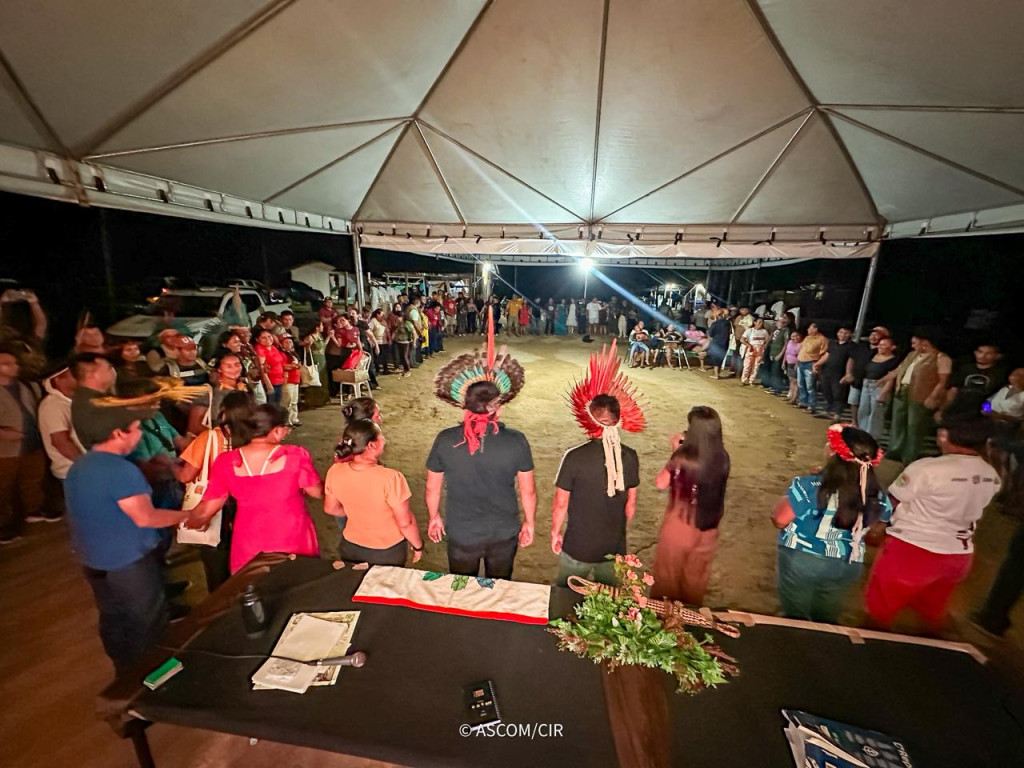
For three days, leaders of the 11 base ethnoregions of the CIR debated important issues for the strengthening and autonomy of the indigenous peoples of Roraima.
Held for the first time in the Anzol Indigenous Community, Murupu region, the First Meeting of the Expanded Deliberative Coordination of the Indigenous Council of Roraima (CIR) marks the strengthening of the struggle to guarantee the rights of the Macuxi, Wapichana and Guajajara peoples, residents of the community. Recently, through the judgment of appeals of the public civil action proposed by the Federal Public Ministry (MPF), it decided that the Union and the National Foundation of Indigenous Peoples (FUNAI) are obliged to complete the process of demarcation of the community, which has been waiting for regularization for more than 30 years.
"We are here to strengthen the Anzol community, which has been waiting for more than 30 years for the demarcation of the territory. They are men, women, young people and children who live surrounded by farms with soy plantations, and the use of pesticides has polluted the few water sources to which the community has access. The beginning of the process of demarcation of this sacred place is a historic milestone for us, indigenous peoples, and for the CIR, which monitors the situation through the legal department", highlighted the general tuxaua-general of the CIR, Amarildo Macuxi.
With three days of programming, debates took place with themes focused on the analysis of the situation on the Time Frame, territorial protection, inspection against mining, indigenous school education and the situation of the T.Is Anzol, Arapuá, Truaru da Cabeceira, Pium/Tabaio, Manoá/Pium and Anaro. The debates were attended by the indigenous organizations Organization of Indigenous Teachers of Roraima (OPIRR), Organization of Indigenous Women of Roraima (OMIRR), Coordination of Indigenous Organizations of the Brazilian Amazon (COIAB) and Union of Indigenous Women of the Brazilian Amazon (UMIAB), as well as representatives of institutions of the Federal and State governments, the regional coordination of FUNAI/RR, among others.
The departments of Communication, Administrative and Financial, Territorial Management, Environmental and Climate Change, Gabriel Ferreira Youth, Projects, Legal, Women, Raposa Serra do Sol Indigenous Training and Culture Center (CIFCRSS), Territorial Monitoring and Surveillance and Rutî Indigenous Fund also provided information on the activities developed in the communities.
"This is a moment when the CIR and its departments are accountable for the actions in the territories to the leaders, and this is very important, in addition to listening to the demands of our bases", emphasized the vice-tuxaua of the CIR, Paulo Ricardo.


Regional coordinators of tuxauas, regional coordinators of women, youth, councilors and traditional leaders with the right to voice and vote were present at the meeting, a space for accountability, debates and evaluation of activities aimed at indigenous communities and the organization, held twice a year, once in the first semester and once in the second semester.
"It is important to be here in the expanded area, to bring the demands of our territories and to listen to institutions, such as FUNAI, about the demarcation of our territories", declared the leadership.
At the end of the afternoon, the RUTÎ Indigenous Fund launched the 2nd Call of the Rutî Indigenous Fund: the fruit of indigenous communities. The second public notice will support 38 projects in the categories: Regional, Community and Family, aimed at the communities that are part of the CIR base. The Rutî Indigenous Fund will provide a total of R$ 2,400,000.00 (two million and four hundred thousand reais).


Deliberations and referrals
Collectively, the leaders approved the deliberations and referrals, including the definition of the date and place of the second Expanded Deliberative Meeting of the CIR, which will be held in the Anaro Indigenous Community, Amajari region, from December 7 to 11.
Support with traditional seeds to regions and communities affected by seed losses due to floods was approved. Also approved were the construction of the Indigenous University pole in the Surumu region, in the Barro Indigenous Community, in the Raposa Serra do Sol Indigenous Training and Culture Center (CIFCRSS); the creation of the Volunteer Brigade in the Amajari region; the convening of the Extraordinary Assembly of the Raposa Serra do Sol Indigenous Land; and the political and legal advocacy in Brasília to monitor the judgment of the Temporal Framework, with a commission of leaders of the T.Is demarcated on islands and in a continuous area.
Also approved was the committee of leaders with the right to voice and vote to accompany the elective assembly of the Coordination of Indigenous Organizations of the Brazilian Amazon (COIAB), which will be held from August 17 to 21, at the Xambioá Indigenous Land, in Santa Fé do Araguaia, in the state of Tocantins.


At the end, the space where the expansion took place was handed over to the leaders of the Murupu region and the Anzol Community.
"This is a very important moment, in which we finalize our expansion in this community, a symbol of resistance in the struggle for demarcation. We thank the Anzol Community for receiving us so well here in the territory. Thank you for the welcome. Thank you to everyone who made this expansion happen", concluded the tuxaua-general of the Indigenous Women's Movement of the CIR.
"For us it was a great effort to handle the entire structure to receive you and, thank God, everything went well. The residents saw how the expansion of the CIR is done, with debates that strengthen the bases", celebrated the regional coordinator of Murupu, Alexsandro Chagas.
In all, 32 proposals were approved and deliberated in the areas of education, sustainability and autonomy of the indigenous peoples of Roraima. The demands, debates and deliberations that took place over the three days are contained in the minutes of the First Meeting of the Expanded Deliberative Coordination of the Indigenous Council of Roraima (CIR).