
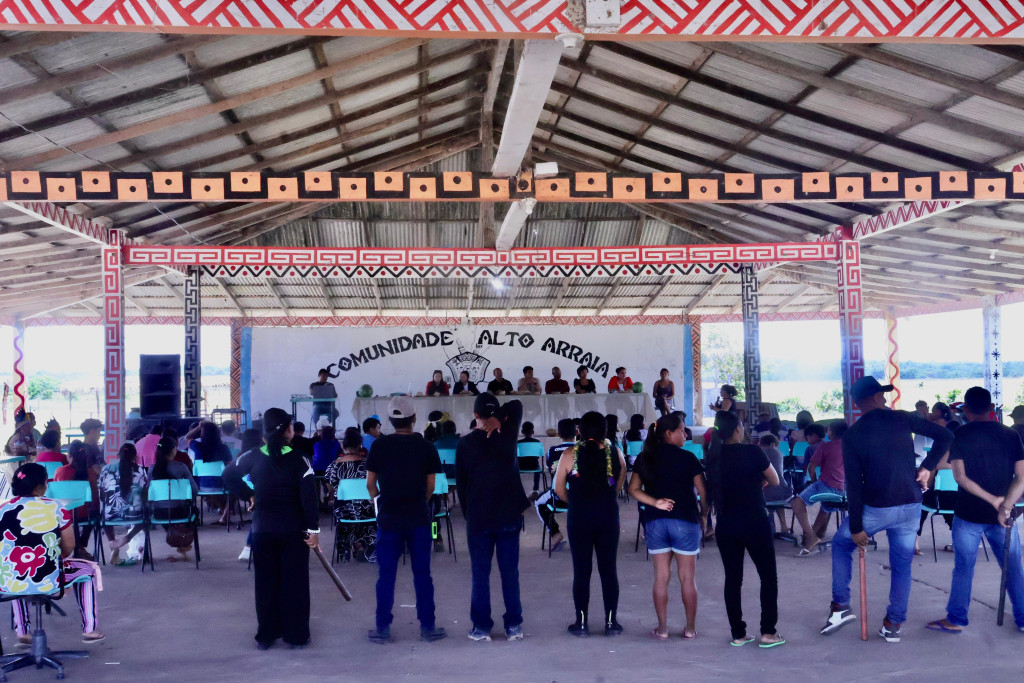
Do you know what an Internal Regulation of an Indigenous community is? Well!
Community internal regulations consist of a set of rules, written or not, that portray the ways of life of indigenous communities. The regiment has always existed and is part of the identity of indigenous peoples. Now, communities have been formalizing these cultural practices, recording the realities experienced in their daily lives.
It is with this objective of increasingly strengthening the autonomy and social, political, cultural and economic organization of the indigenous communities of Roraima, three more indigenous communities in March carry out the process of drafting the Internal Regulations. This time it was in the communities of Alto Arraia, Jabuti, both in the Serra da Lua and Vida Nova region, Aningal Indigenous Land, Amajarí region.
During the Serra da Lua Regional Assembly, held in the Moscow indigenous community, Tuxaua Corina Ribeiro, requested support to prepare the internal regulations of the Alto Arraia community and invited the legal counsel of the Indigenous Council of Roraima (CIR) to assist in this process.
At the invitation of the other communities, the legal team of the CIR, Dr. Junior Nicacio and Dr. Fernanda Félix, both from the Wapichana people, in addition to the interns Barbara Laurentino and Luciano Gomes, were in the three communities, to pass on guidelines and support the construction of the document. Demonstrating protagonism, they organized meetings with the participation of their members and leaders, teachers, elders, young people, women and children. In this sense, the legal department has been carrying out periodic visits to the indigenous communities, answering questions and contributing in a didactic way to the discussion, letting the community and its leaders follow the discussions according to their community calendar.
Between March 24 and 28, the residents of the Alto Arraia community, Serra da Lua region, met to discuss and write their internal regulations. The legal counsel was present on the first day to support the structuring of the work and returned on the 28th to clarify doubts and monitor progress.

Seven thematic Working Groups (WGs) were formed to discuss fundamental aspects of community organization, such as the history and formation of the community, identity, the right to consultation, the rights and duties of residents, community heritage, the environment and territorial surveillance, and the resolution of internal conflicts, among others. The Tuxaua of the Corina Ribeiro community, of the Wapichana people, about to complete 10 years as a tuxaua, considered the historic moment.
"We organized our ideas to document our coexistence between teachers, Indigenous Health Agents, women, young people, children and traditional leaders. I consider this to be a historic moment for my community and soon we will conclude our regiment"

The Nova Vida and Jabuti communities are already in the completion phase, construction began in 2019. Tuxaua Adrelino Marcos, from the Jabuti community, Serra da Lua region, highlighted the importance of drafting the regiment."The regiment is of paramount importance for my community. With this, it will bring rules for the population that is here. So, we had this deficit for our community, and today it is fitting in", said the tuxaua.

The Vida Nova Indigenous Community, located in the Amajari Region, about 200 km from Boa Vista, is made up of families from the Macuxi, Wapichana and Sapará peoples, who live through the production of family farming, cattle ranching, hunting and fishing and other activities.
The second Tuxaua, Osmundo Ribeiro, expressed his joy with the participation of the children in the construction of the regiment, according to him, they will tell the history of the community, being a milestone for the future, as he values the history of creation of the community and the names of those who were present. But he showed concern about enterprises that surround the community.

The CIR lawyer, Júnior Nicacio, from the Wapichana people, presented examples of regiments from other communities, reinforcing that each one has its particularities, according to the local reality. "Each community has its needs. The important thing is that the rules are built collectively, ensuring justice and safety for all." Said the lawyer.
It is important to highlight that this process is born from the initiative of the communities themselves, and the CIR, through its advisory, acts as a partner in this collective work, reaffirming its commitment to the autonomy and strengthening of the rights of indigenous peoples.