
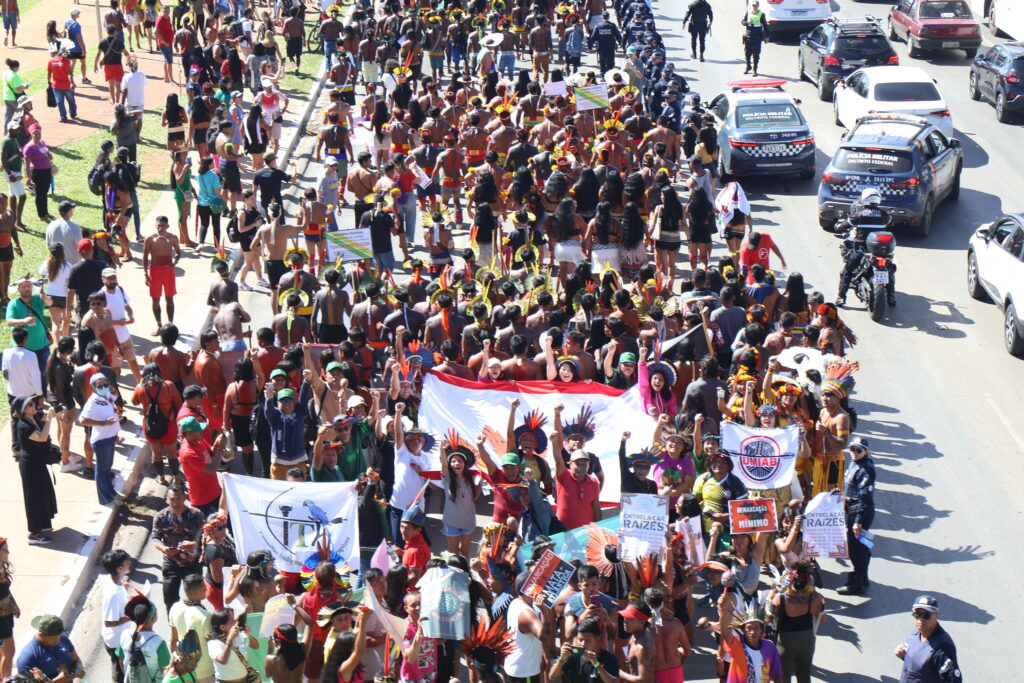
Roraima, a state with more than 90 thousand indigenous people, was present in the largest indigenous mobilization in the country, the delegation had about 60 leaders, from the ethnoregions that make up the base of the Indigenous Council of Roraima (CIR). Regions, Amajari, Alto Cauamé, Baixo Cotingo, Surumú, Raposa, Serras, Wai-wai, Yanomami and Serra da Lua. Each one with reports of threats and even death, for the struggle for the demarcation of their territory, in this case we cite, as an example, the regions of the Raposa Serra do Sol Indigenous Land.
Among the debates are the invasion of illegal mining territory, the mental health of indigenous peoples and especially the demarcation of indigenous lands, which has been threatened by the approval of the Time Frame in the Senate and the latest events around the subject, which in recent days, has taken another turn after the decision of Minister Gilmar Mendes.
The minister suspended all actions that deal with the time frame and the application of Law 14,701/2023, until the Federal Supreme Court (STF) decides definitively on the matter or until a possible decision by this court to the contrary. Such a decision is seen by the indigenous movement in Brazil as a way to negotiate original rights, a worrying situation, in the understanding of the network of indigenous lawyers in the Brazilian Amazon.
“Our concern is that there is an alignment "behind the scenes" between the federal government, the STF and the National Congress to propose "negotiations". They can even propose the regulation of article 231 of the federal constitution, that is, a new bill may come that will deal with all this. We need to be very attentive to what the federal government and the national congress can propose", explained Ivo Cípio, legal advisor to the CIR and member of the network of lawyers.

On April 25, President Lula received about 40 leaders of the indigenous movement, the reception took place in the midst of the march "Our Milestone is ancestral – We have always been here", led by the youth.
Edinho Batista, General Tuxaua of the CIR, accompanied the meeting and pointed out the president's speeches as strategic, to soften the spirits, given that the meeting took place during the march "Our Territory is Ancestral", which mobilized about eight thousand indigenous people and also a significant number of police officers.
"We took this issue to the president and reinforced the demarcation of lands that have not yet been made, our relatives are suffering, with greed and destruction of territories, especially in the states that are part of the Brazilian Amazon, the president promised that he willmake theDemarcationdthe six lands that were going to be, but notweredemarcated, and we will wait, if it is not done,we indigenous peoples are going to mobilize in the territories," said Batista.

With posters, banners, and objects that called for the demarcation of indigenous lands, and the total overthrow of the Time Frame, the march went along the access road to the headquarters of the central plateau, to the sounds of maracás were echoed cries of resistance and traditional dances. The Youth Coordinator of the Raposa region, Paulo Ricardo participated in plenary sessions, conversation circles and in the march he was on the front line, along with the other young people, for the right to life and not to the time frame.
"We, as a young leader and indigenous movement, are here to write our history, we are in the ATL, to leave our mark of struggle and resistance of the strength of the indigenous movement of Roraima. We have the mission of continuing the trajectory of our leaders, the headdress, maracá and the staff, so we are here firm and strong in the struggle," said Paulo.
Agendas in ATL
The embattled indigenous youth also participated in other debates, in the plenary; Mental Health and Good Living of indigenous peoples, together with a representative of Funai and indigenous psychologists, Raquel Wapichana, coordinator of the Department of Indigenous Youth, expressed concern about the issue, stating that young people need differentiated care, whether in the community or outside it, and asked that mental health be in fact and continue to be guided in the most diverse spaces.
"Talking about mental health is important, especially when it is about the mental health of youth, it is not just about arriving here is to give a lecture, or arrive at theTerritoryDo a lecture and that's it to leave the subject aside It is indeed necessary develop actions to combat these evils in the territories. In Roraima, we are workingexchangeamong young people the experiences in different communities, strengthens young people" Said Raquel.
The coordinator also stated that the indigenous movement saves lives, based on reports of young people who have gone through great overcomings, shared in the seminar on mental health.

The regional coordinators, together with the General Tuxaua of the Indigenous Women's Movement, Kelliane Wapichana, participated in the Extraordinary Assembly of UMIAB (Union of Indigenous Women of the Brazilian Amazon), where the reformulation of the organization's statute and the election to choose the new coordination of UMIAB were discussed.
"We are here to strengthen UMIAB, and to say that we women of Roraima are here to support each other, so that our voices are heard, explained Wapichana.
On the occasion, Leirijane Nagelo, from the Macuxi people, tuxaua from the Morcego community, T.I Serra da Moça, Murupú region, was presented as a candidate to run for the election of the Coordination, in November, during the general assembly that will take place in Lake Caracaranã.
"I was nominated at the 53rd General Assembly, and today I am here getting to know even more about the reality of UMIAB, knowing how the statute works, because being at the head of an organization at the level of the Brazilian Amazon is a very big responsibility," said Macuxi.

Strategies of indigenous advocacy for the defense of rights, was one of the plenary sessions that took place in the tent of COIAB (Coordination of Organizations of the Brazilian Amazon), the leaders shared their concerns and clear doubts about the legal issues of the Time Frame, Ivo Cipio, who like the other lawyers, closely follows the situation, explained clearly the consequences on the Time Frame.
"We overturned the time frame in the STF. Time frame is a lie, there is no provision in the text of the constitution. But the parliamentarians who hate indigenous peoples, took PL 490 and turned it into law 14701/23, and the ruralists and other interested parties file a lawsuit with the STF, asking the supreme court to declare the law constitutional, which means that the supreme court says that this law is in accordance with the constitution, but we know that it is not," said the advisor.
Other incidents occurred during the four days of programming of the Free Land Camp, and had the active participation of the delegation from Roraima, showing the importance of the space for discussions at the national level, even though it has a diversity of peoples, the struggle is unique to the demarcation of the territory.
About ATL
The largest indigenous mobilization in Brazil, the ATL (Free Land Camp), completed 20 years of creation, it was born to give voice and visibility to the experiences of indigenous peoples from all regions and biomes of the country. A place of debate, for the guarantees and protection of original rights, between authorities and those who feel the ills faced in the territory, a space for union, struggle and resistance.
"Free Land" arose from the theme of the Tuxauas Assembly, held in 2004, in the Maturuca indigenous community, mountain region, T.I Raposa Serra do Sol, at the time the theme of the assembly was "Free Land, Life and Hope", according to reports by Joenia Wapichana, a period in which she was legal advisor to the CIR, and was part of the delegation of leaders that went to Brasilia, to take the claim for the demarcation and homologation of the Raposa Serra do Sol indigenous land. To tell the history of this mobilization, a kind of time tunnel was set up in the middle of the Funarte square in Brasilia, on the walls images of historical moments of the first ATLs.
A legacy of a lot of struggle and resistance, in the photos Mr. Ivaldo André, from the Maturuca community, Serra region, Mrs. Tereza Macuxi, Davi Kopenawa, Yanomami leader and in memory Jairo Pereira, a leader who left a legacy of much struggle for the demarcation of the territory, hoped to see the Morcego community in which he was a tuxaua. Fabiano Paulino, vice-coordinator of the Raposa Serra do Sol Indigenous Land, participated for the first time in the ATL and learned about the history of protagonism of the indigenous movement of Roraima. The first free land encampment was in 2004, when the occupation in front of the Ministry of Justice promoted by the indigenous peoples of Brazil took place.
"Here we can see the images of the leaders who began this trajectory, there are photos of the relatives of our land, indigenous people, who always sought the best for their people, some are no longer here, so it is very important to know this legacy, because it is we young people who will continue their struggle, and this timeline tells that", concluded Fabiano.