
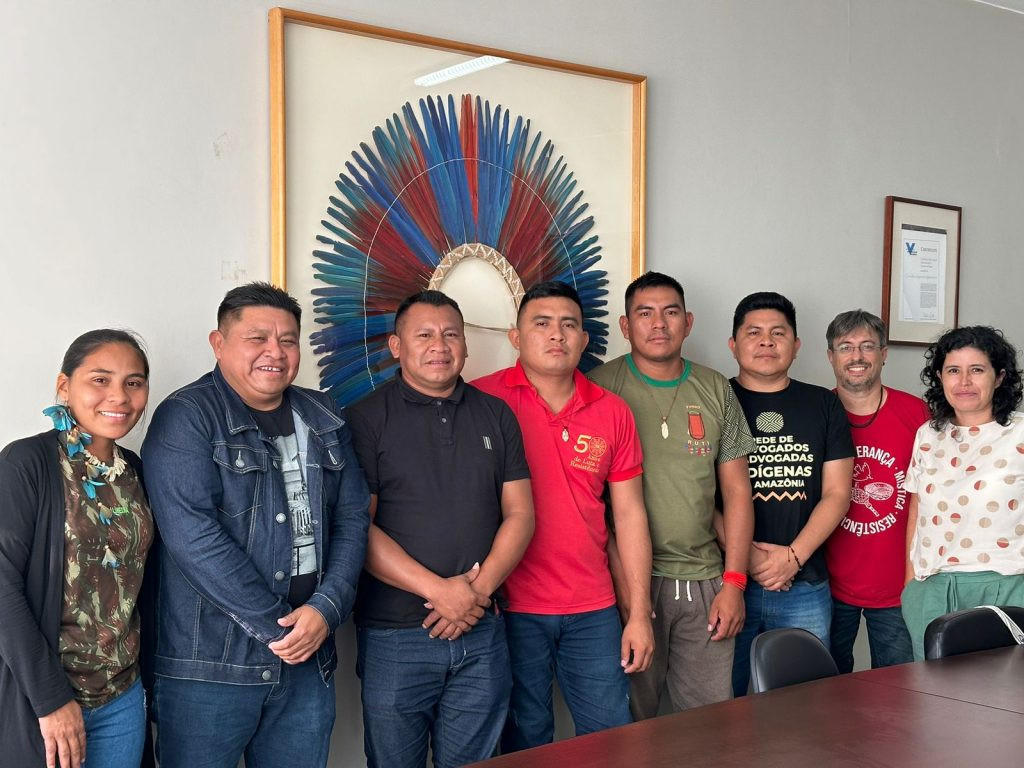
Continuing the mobilizations and political advocacy against the temporal framework, mainly around the discussions at the conciliation table of the Federal Supreme Court (STF) regarding Law 14.701/23, a commission of indigenous leaders from Roraima began an advocacy agenda in Brasília, with meetings at entities, federal public bodies, ministries, and, as the commission's main focus, at the Federal Supreme Court (STF). The agenda began today, August 19th, and continues until the 30th.
The delegation, composed of the Executive Coordination, legal counsel from CIR, and indigenous leaders, met this afternoon with the national secretary of the Indigenous Missionary Council (CIMI), Luiz Ventura, and his legal team, updating information and strengthening strategies to face the next stages of the conciliation process, whether participating or not, but maintaining the firm position of the indigenous movement of Roraima in not negotiating rights.

They also had meetings at the headquarters of the Articulation of Indigenous Peoples (APIB), with the executive coordinator of APIB for the Amazon, Kleber Karipuna, who presented the current situation regarding the conciliation table, the strategies of the indigenous movement, and other actions to confront projects that threaten indigenous rights.

The regional coordinator for the Serras region, Amarildo Macuxi, the chief Lázaro Wapichana, the coordinator of the Indigenous Youth of Raposa, Paulo Ricardo, and the legal representative for the Alto Cauamé region, Ana Cláudia Ribeiro, leaders who make up the delegation, bring to the federal capital the voice and strength of the indigenous peoples of Roraima.
The general chief of CIR, Edinho Batista, emphasized that the agenda in Brasília is to continue the struggle. "It's necessary to carry out mobilizations in the state, in the regions, and also in Brasília, where the powers are concentrated, and bring the message of those who cannot reach Brasília," he stressed.

To ensure there is no change in the decision, Amarildo highlighted the importance of strengthening the 2023 Supreme Court decision, which rejected the temporal framework thesis. Meanwhile, Chief Lázaro warned that the temporal framework is affecting indigenous lands, with invasions of territories and threats to indigenous leaders who are on the front lines of this struggle.
Young Paulo Ricardo stated that the time frame for the conflict has already expired, since last year, and that now it is important to maintain the stance of the indigenous movement to fight against agribusiness, mining, and other projects.
Meetings have already been requested this week with federal government agencies, ministries, and other entities that support the cause of indigenous peoples.