
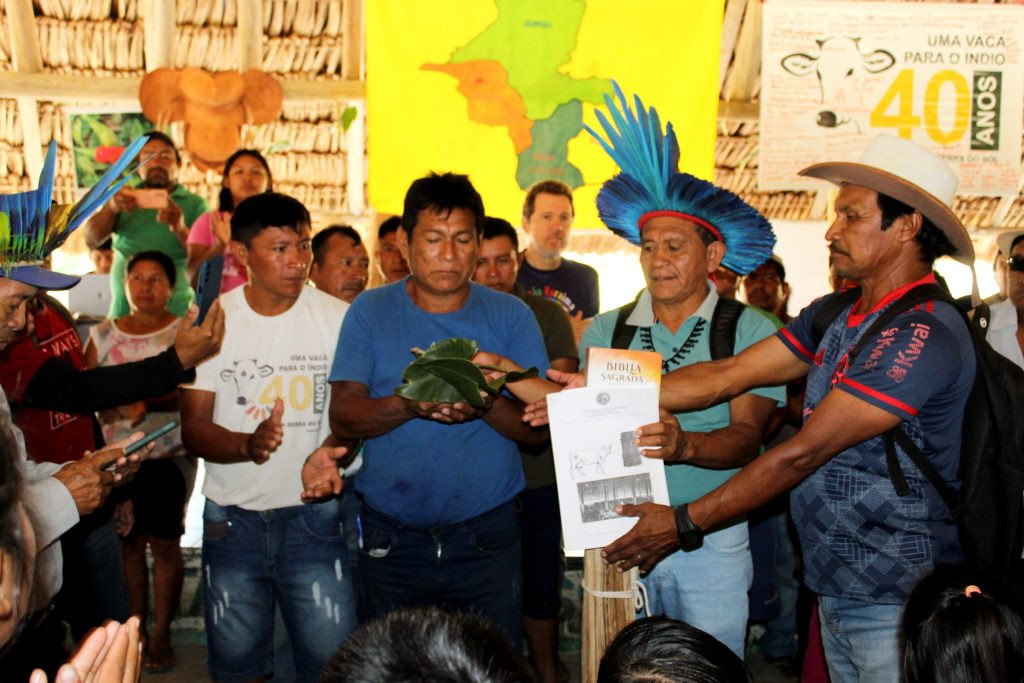
Approximately 200 indigenous leaders from the Serras region are participating in the Regional Assembly of the M+ Cattle Project, held at the Regional Center in the Maturuca indigenous community. The meeting, which symbolizes unity and commitment to defending the territory, is marked by a bundle of sticks, soil, and a plant, representing the historical importance of the project.


The M+ cattle project is considered one of the essential pillars for the conquest of the Raposa Serra do Sol indigenous land. Created in 1980, it provided 52 head of cattle to each community, with the commitment at the end of five years to deliver the same number of cattle to another community.
The regional assembly seeks to strengthen this achievement and ensure that the project's principles are respected and implemented in the communities.

The project coordinator, Nilo Batista, highlighted the importance of the assembly for debating and clarifying doubts about the project. “In these days, we will discuss and debate the functionality of our cattle project. I am observing that our communities are not complying with the project's bylaws,” Batista assessed.
On that occasion, the leaders present shared their experiences regarding the implementation of the M+ cattle project (One Cow for the Indigenous People Project).
The leader, Jacir José de Souza, Tuxaua of the Bem Viver community, recalled the challenges faced at the time. "It wasn't easy to get the cattle project, we fought hard, we were threatened by ranchers, miners and invaders," the tuxaua remembered.
Other leaders, such as Inácio Brito, Lucio da Miguel, Jacinto de Souza, and Luzete Moreira, reinforced this struggle. “If it weren't for the cattle ranching project to occupy our territory, we certainly wouldn't be here, but through our struggle and project we managed to conquer our territory. We had a serious commitment; we were all in agreement with everyone. We are very grateful for the presence of the missionaries; they showed us all good paths,” the leaders emphasized.
With the intention of implementing the cattle project in the Wai-Wai territory, leaders such as the regional coordinator Alexandre Wai-Wai and other leaders also participated in the Assembly, seeking knowledge about the project and the historical experience of the indigenous peoples of Raposa Serra do Sol in relation to cattle raising.
With two days of programming, the assembly concludes today (February 12).
Information and photos: Jacir Souza - Communicator for the Wakywwa Network.
Text revision: Mayra Wapichana.