
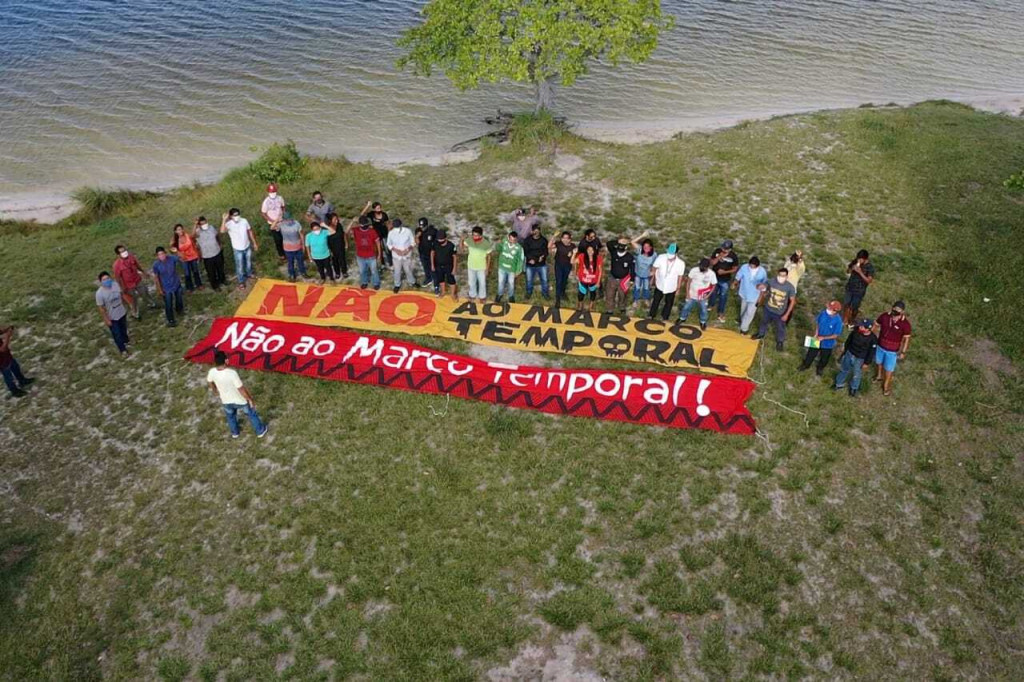
The Indigenous Council of Roraima (CIR) held on November 11 and 12 at the Lago Caracaranã Regional Center, Raposa region, Raposa Serra do Sol Indigenous Land, the XII State Meeting of Indigenous Law Operators. With the theme: "Territory and Indigenous Peoples: Protecting Our Land", the main agenda for discussion was the "time frame", a thesis defended by the ruralist caucus that seeks to restrict the constitutional rights of indigenous peoples over their territories.
The meeting, which is held by the CIR's legal counsel once a year, has been held since 2001. This year, due to the pandemic, all preventive measures against the new coronavirus were taken, such as the use of masks, hand sanitizer and distancing. 40 people participated, including indigenous law operators and regional coordinators of the Indigenous Territorial Protection and Surveillance Group (GPVITI).
The objective was to strengthen indigenous leaders in the face of various threats and violations of rights. But the legal advice of the CIR already seeks to provide continued training in the area of indigenous rights, focused on territorial rights and other social rights such as education, health, knowledge about the Federal Constitution, ILO convention, among other laws that deal with indigenous populations in Brazil.
After the discussions, the leaders spoke out against the thesis of the time frame that can define the future of Indigenous Lands in Brazil and in which the trial was initially scheduled for October 28, but was suspended. With a banner to say "No to the Time Frame", the leaders gathered on the shores of Lake Caracaranã, one of the symbols of the struggle for the demarcation of the Raposa Serra do Sol Indigenous Land. The illustration of the banner was made by indigenous artist Bartolomeu Silva Tomaz, Bartô, of the Patamona ethnic group.
The topics discussed were, in addition to the time frame thesis, cases of violation of the right to consultation, such as the Draft Legislative Decree (PDL) 28/2019, which excludes the seat of the municipality of Pacaraima, from the São Marcos Indigenous Land, PL 191/2020, which intends to open Indigenous Lands to mining and hydroelectric dams, among other projects, which deal with indigenous rights in the National Congress. Also discussed was the draft law for the construction of the Bem Querer Hydroelectric Power Plant (HPP), the expansion of the shoulder of BR-174, Linhão do Tucuruí in the Waimiri-Atroari Indigenous Land, and a grain planting project in the T.Is.
"It is essential to inform operators and GPVITs what is happening these days, about indigenous rights, what the threats are. The central theme we addressed was the time frame thesis, but we also discussed the issue of the right to consultation, which is a right that is being violated during this Covid-19 pandemic, along with the norms and rules of communities and territorial management", explained the coordinator of the CIR's Legal Department, Junior Niccacio.
Dona Francinete Garcia, Macuxi ethnic group, from the Novo Paraíso community participated in the meeting and evaluated the time frame thesis as a violation of the rights of indigenous peoples. "All of us who participated will inform the people of our communities how our rights are being violated, especially in this case of the time frame."
Another topic that was addressed on the second day of the meeting, the right to land and the protection and surveillance mechanisms. And the leaders received guidance from the CIR psychologist, Iterniza Pereira, who spoke of the importance of mental health and the prevention of prostate cancer, alluding to the month of Blue November. At the end, participants from all regions prepared an action plan for 2021. The event was supported by the Ford Foundation.