
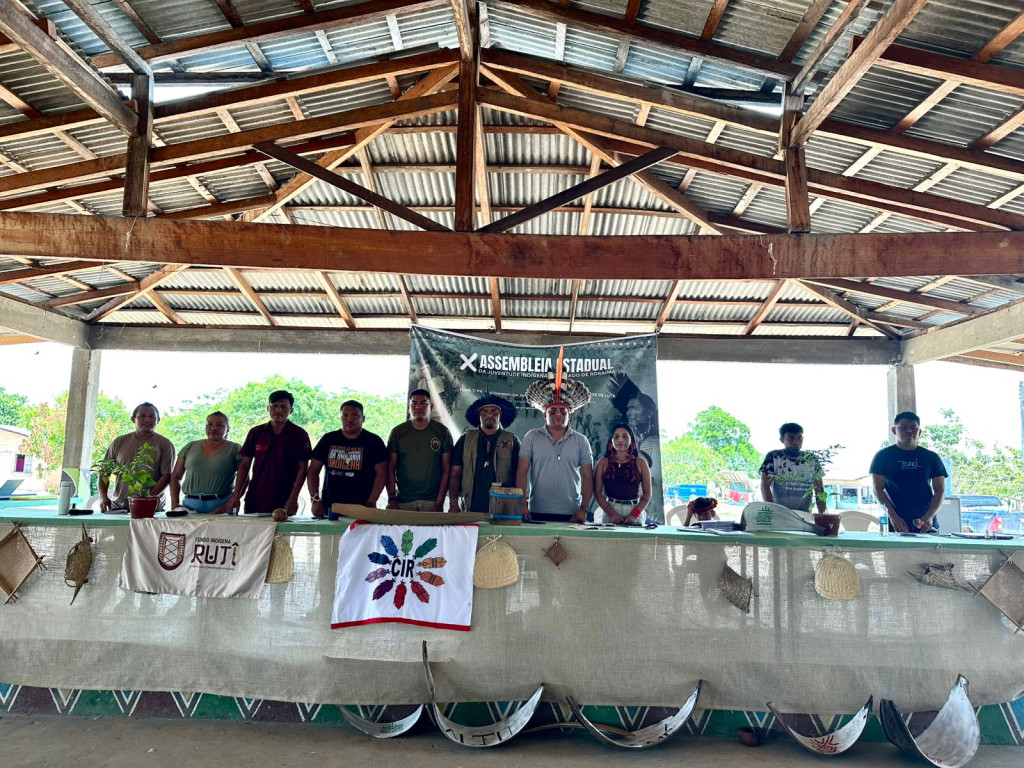
The event brings together young leaders and representatives of institutions for moments of reflection, spirituality, and political strengthening. The second day of the program began with a prayer, followed by a protection ritual led by the shaman Mariana, who performed the traditional practice of putting pepper in the eyes, a spiritual ceremony of indigenous peoples.
Following the spiritual moment, participants began the day's agenda with the theme: "The protagonism of indigenous youth in spaces of struggle: what is our mission in the spaces we are occupying?" The discussion brought together representatives from various institutions, such as the Federal University of Roraima (UFRR), the National Foundation for Indigenous Peoples (Funai), the National Council for Indigenous Policies (CNPI), the Coordination of Indigenous Organizations of the Brazilian Amazon (Coiab), the CIR Coordination, the CIR Youth Department, and the Rutî Indigenous Fund.


In the context of training, resistance, and occupation of spaces, Jucilene Carneiro, a professor in the Indigenous Territorial Management course at the Insikiran Institute of UFRR, highlighted the importance of educational training for young Indigenous people. “You need to define the paths, and one of them is education. It's not easy, there are many challenges, such as prejudice, but we need to occupy these spaces. The positions that exist there are the result of a lot of struggle. The Insikiran Institute is a result of the indigenous movement and is our territory within the university. Insikiran doesn't exist without a foundation.”
Romeson Viriato, Monitoring Assistant for the Rutî Indigenous Fund, emphasized the importance of focus and purpose on the journey."When we talk about spaces for struggle, we need to reflect on our objective, what we want, and where we want to go."
The deputy coordinator of Coiab, Alcebias Sapara, shared his leadership journey, which began at age 16.“It all started with the youth movement. Today we are building this space; you are COIAB. I am 30 years old, and many of those years have been spent fighting. Take advantage of the opportunities, live your adolescence responsibly. Value every moment here in the assembly.”
Lázaro Wapichana, 24 years old, currently working at Funai/RR, highlighted the importance of the formative moment experienced by the young people present.“I never imagined being in an institution like Funai. You're not missing class for nothing. This is a space for dialogue and building. You have the capacity to occupy these institutions; you just need to maintain your essence.” He concluded by saying: “Value each step and achievement with your families. You are capable of realizing your dreams. Don't give up.”
Lucas, from the Wapichana people, from the Taxi community in the Surumu region, is 25 years old and holds an alternate position on the CNPI. He emphasized the importance of youth engagement.“I admire the work we do at CNPI. We deal with public policies for our communities. I am a product of the grassroots, shaped by my leaders. The knowledge acquired here is immense and should be used to help our people. Today I am at CNPI; tomorrow it could be any one of you.”


The deputy chief of CIR, Paulo Ricardo, 23 years old, from the Macuxi people, from the Raposa region, spoke about the sacrifices made to assume greater responsibilities.“We had to give up many things to be here, even family dreams. But if you want something big, you have to give up something big. Responsibilities begin with ourselves, with sincerity and self-respect.”
Raquel Wapichana, coordinator of the Youth Department, concluded with a call for resistance and persistence.“Our mission is very big. This year is a year of evaluation. I have never bowed my head to anything. Being at the head of the department is an immense responsibility.”
The second day began with inspiring speeches and activities that promoted integration, collective strengthening, and reflection on the fundamental role of indigenous youth in building a representative present and future.
Photos: Charles Taurepang- ASCOM/CIR, Wey Tenente, Kamilla Krislayne, Denismar Batista and Gleydson Luan- Wakywaa Network: Amajari, Serra da Lua, Baixo Cotingo and CIFCRSS.