
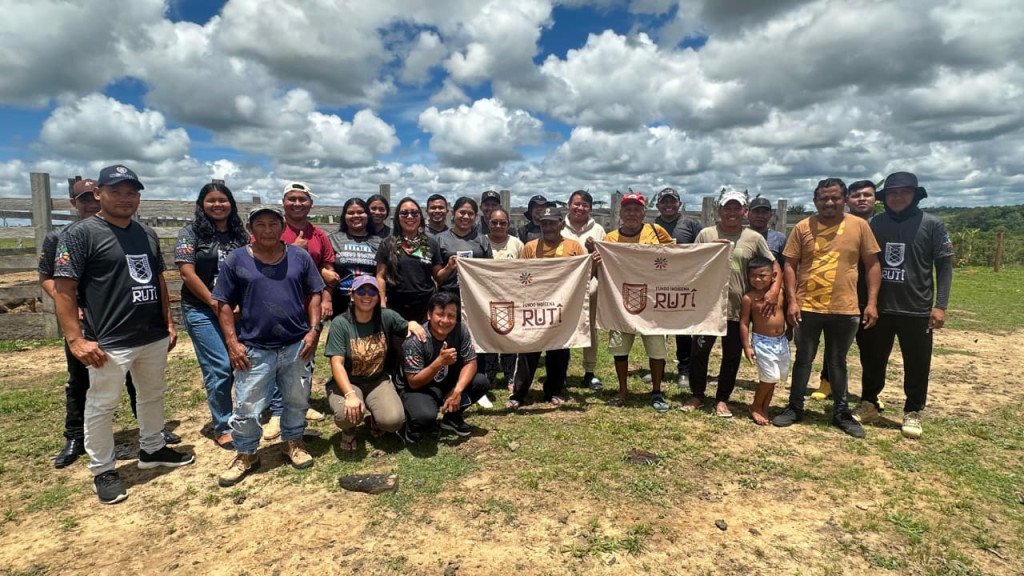
O I Training Meeting with the Project Articulators of the Rutî Indigenous Fund, of the Indigenous Council of Roraima (CIR), supported by the International Institute of Education of Brazil (IEB) and the Royal Norwegian Embassy, met on April 22 and 23, 2026, regional articulators and the technical team at a time marked by the exchange of experiences, institutional strengthening and alignment of strategies for the execution, in addition to monitoring projects in indigenous communities.
A official opening was attended by the tuxauas of the Indigenous Council of Roraima (CIR), Amarildo Macuxi, Paulo Ricardo and Kelliane Wapichana, followed by prayer and presentation by the Rutî Indigenous Fund team. The articulators were presented, highlighting their fundamental role in connecting communities, leaders and the fund's technical team.


A of the memorable moments, was the presentation of the department's timeline of the Rutî Indigenous Fund, led by the deputy tuxaua general of the CIR, Paulo Ricardo, and by the leadership Enock Taurepang. The activity rescued the trajectory of the initiative, its advances and future prospects.
A The program also included the institutional presentation of the Fund and the importance of the articulators of indigenous projects in the regions, with a presentation the coordinator of the Fund, Josimara Baré and the Political Articulator, Cirilo Macuxi. Next, technical visits and monitoring of the contemplated projects, in addition to guidance on reports, use of systems and fieldwork, conducted by the Monitoring Assistant, Romeson Makuxi and the EngineerAgronomist, Geraldo Way Way.

A lecture "Techniques and challenges of territorial monitoring", given by Vanessa Ferreira, brought reflections on the challenges faced in the communities and strategies for the efficient monitoring of projects. O The meeting also featured dynamics between the articulators, promoting integration and exchange of experiences.
How part of the program, a field visit was carried out on April 23, 2026, where participants were able to learn about initiatives supported by the fund. In the Paakayamî' pêanna senkkamamî' Family Project, in the Tabaio region, the coordinator Cosmo Viriato highlighted the progress made.
"We we work with cattle in Boqueirão, and when the Rutî project came about, we had the idea of writing ours. We got the artesian well and today we have water. Our project is very good and I embraced this cause."


Other visit was the community healthy eating project in the Pium community, also in the Tabaio region. The initiative, developed by family groups, seeks to promote sustainability and improvement in the quality of life through the cultivation of foods such as passion fruit, papaya, cassava, cassava, beans, pumpkin and watermelon. According to the project coordinator, Tuxaua Macicleide said that "I support of the Rutî Indigenous Fund has been essential for strengthening the actions".
During the meeting, the tuxaua Paulo Ricardo reinforced the strategic role of the articulators. "Articulators have a fundamental function within the territories. They will closely monitor the execution of the projects, assisting, seeking partnerships and bridging the gap between communities, leaders and the fund team."
Paul He also highlighted that the training represents an organizational advance and strengthens regional development, in addition to providing the new articulators with a broader understanding of the history, objectives, and importance of the Indigenous Fund Rutî.


A coordinator of the Fund, Josimara Baré, stressed that the meeting is the result of a collective effort and an old dream of the organization.
"This It is a moment of much exchange of experiences and strengthening of the monitoring of projects. In addition to financing, the fund also monitors ensure that the initiatives are actually implemented. This training expands our work with articulators who already have a link with the communities."
Daniel Macuxi, from the indigenous community Taxi, Surumu region, Raposa Serra do Sol Indigenous Land, participated in the meeting and highlighted the importance of these trainings for the articulators.
"It was a very good initiative by the Indigenous Council of Roraima, through the RutÎ Indigenous Fund. Today, this action is training each designer indicated by their bases, offering training with learning about the preparation of reports and attachment of photos and videos. Then, these designers return to their communities prepared to support their leaders and further strengthen the projects that are being developed in regions, communities and family groups. This is a a very important process. It is a continuous training, a training which will continue. We are very grateful to the CIR for providing this training for project articulators."