
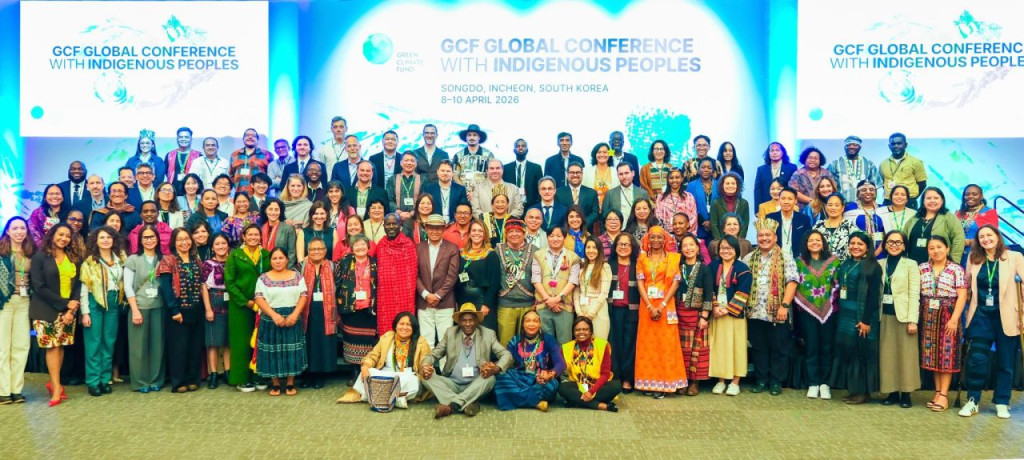
In order to bring the voices of indigenous peoples in Brazil to international debate, reinforcing the importance of protagonism and the fairest, most accessible, and effective paths for climate finance, the coordinator of the Rutî Indigenous Fund of the Indigenous Council of Roraima (CIR), Josimara Baré, participated between April 8 and 10, 2026, in the first conference with indigenous peoples promoted by the Green Climate Fund (GCF), in Songdo, South Korea, accompanied by Yara Martinelli, interpreter and advisor to the leadership, working on issues related to climate finance and intercultural governance.
The meeting brought together leaders, indigenous organizations and representatives of international institutions. During the conference, Josimara Baré shared the experience built in Roraima and highlighted initiatives that put indigenous peoples at the center of decisions.
In this scenario, the Rutî Indigenous Fund, an initiative of the CIR, presents itself as a concrete response built from the territories. With two years of operation, the fund has already positioned itself in national and international spaces as its own support mechanism for indigenous communities, based on listening, collective organization and the autonomy of peoples.
During the dialogues, one of the main points raised was the need for indigenous peoples to stop being seen only as beneficiaries of projects and to be recognized as protagonists in the definition of priorities, resource management and implementation of actions in their own territories.
“If the Green Climate Fund (GCF) wants to seriously advance Indigenous people-led climate finance, it needs to recognize the importance of existing Indigenous funds as part of the infrastructure of this solution, rather than as one-off actors. It is also critical to create real pathways for preparation, institutional strengthening and partnership for these funds.", said Baré.


This reflection dialogues directly with the trajectory of the Rutî Indigenous Fund, which was born precisely for this purpose: to strengthen initiatives built by the communities themselves, respecting their forms of organization, their times and their ways of decision-making.
Over the years, the CIR has been consolidating experiences of training, articulation and support for the indigenous communities of Roraima. The Rutî Indigenous Fund emerges as a further step in this process, creating its own financing mechanism that seeks to overcome competitive models that are distant from the reality of the territories.
Unlike many traditional formats, in which communities need to compete for resources through complex technical proposals, the Rutî Indigenous Fund bets on the collective construction of priorities. By listening to leaders, dialogue between regions, and identifying real needs, the process seeks to strengthen cooperation, avoiding inequalities and internal disputes.
This model is also connected to global discussions on climate and forests, which recognize the importance of indigenous peoples in protecting territories and maintaining biodiversity. However, the CIR reinforces that any initiative in this field must ensure respect for the rights of indigenous peoples, including free, prior and informed consultation, as well as control over decisions that affect their territories.
Another point highlighted in the debates is the importance of investing in the preparation of indigenous organizations to access and manage resources autonomously. This includes strengthening teams, management, monitoring and communication systems, elements that have already been worked on by the CIR through its departments and integrated action with the communities.
For the Rutî Indigenous Fund, this moment represents the consolidation of a path built from the territories, in which access to resources must go hand in hand with autonomy and the strengthening of community organization.
More than participating in these spaces, the CIR reaffirms that the answers to climate challenges involve the recognition of indigenous peoples as protagonists, with solutions that are born in the territories, based on their knowledge, their practices and their own form of organization.
Photos: Yara Martinelli and Archives/GCF.
Text: Charles Taurepang (ASCOM/CIR).
Revision: Márcia Fonseca (ASCOM/CIR).