
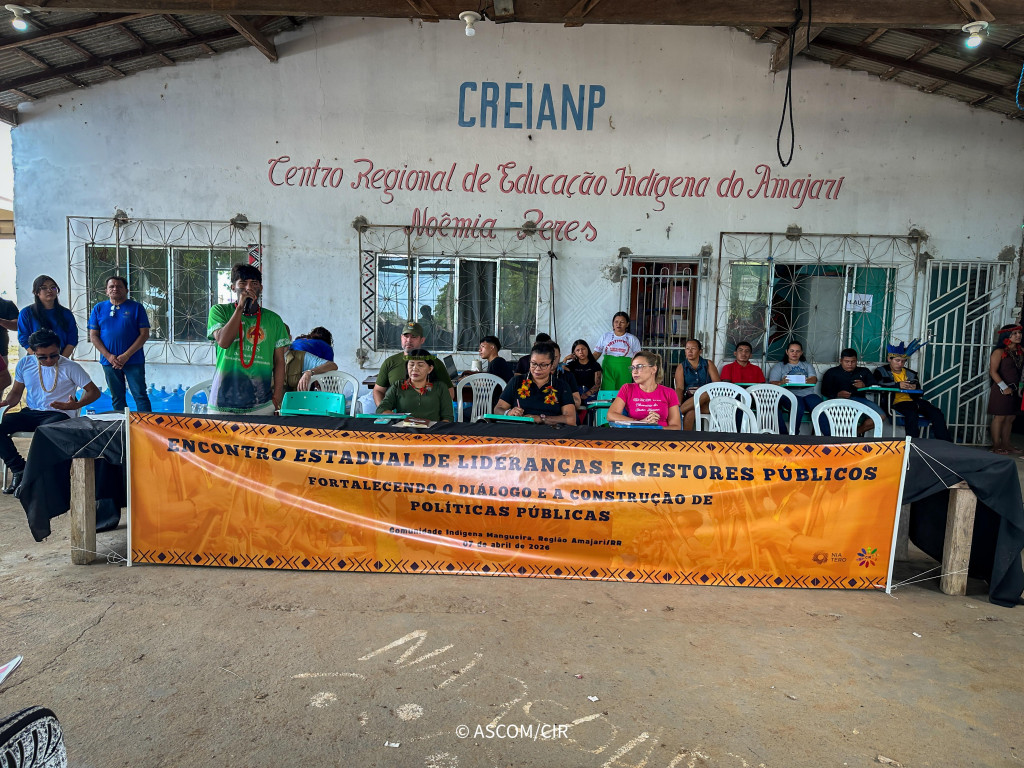
The state meeting Leaders and Public Managers - Strengthening dialogue and the construction of public policies, took place on the morning of Tuesday (7), at the Regional Center for Indigenous Education of Amajari Noêmia Peres (CREIANP), during the ATL/RR.
Held by the Legal Department of the Indigenous Council of Roraima (CIR), the table mediated by indigenous lawyers Fernanda Wapichana and Luciane Macuxi, the meeting was planned to strengthen the understanding and advocacy of indigenous leaders on public policies, promoting an accessible, participatory and direct space for dialogue between leaders and public managers.
The meeting was attended by indigenous leaders, representatives of the UFRR Human Rights Observatory, the Program for the Protection of Human Rights Defenders, Communicators and Environmentalists (PPDDH), regional coordination of the National Foundation of Indigenous Peoples (FUNAI), and representatives of indigenous students from the Insikiran Institute of UFRR.
Priscila Cardoso, coordinator of the Human Rights Observatory, highlighted what public policies are, how they can be accessed and why they exist and reinforced that indigenous peoples have self-determination to define how the State should relate to indigenous peoples, to carry out public policies, with free, prior and informed consultation.
"Indigenous peoples have the right to decide how health should reach their community, how education should be carried out in their community and especially how management should be done in their territory", said Priscila.


Marizete Macuxi, regional coordinator of FUNAI/RR, presented part of the services available by the institution to the indigenous people, reinforcing that the role of the agency is to support, monitor and inspect the way public policies are carried out in the territory.
"In addition to partnerships to strengthen the public policies that already exist in the communities, whether in the areas of health, education and infrastructure, we have the role of supervising how they are implemented", said the coordinator.
It was a morning dedicated to answering questions, presenting demands and adding knowledge with indigenous leaders. Divided into three groups; youth, men and women, the public policies necessary for good living in the communities were scored. One of the points mentioned was about respect for the social organization of indigenous peoples.
"This was a very important space, thinking for you to point out and claim the demands in the various areas, I reinforce that what is presented here will be part of the final letter of the Indigenous Movement"highlighted Luciane Macuxi.