
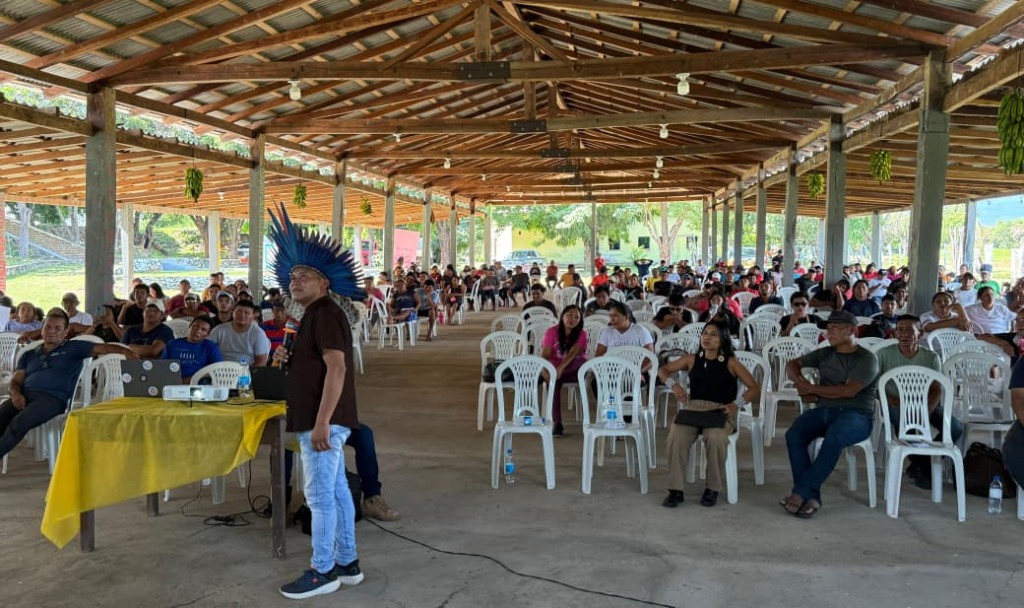
The executive coordination of the Indigenous Council of Roraima (CIR), represented by Amarildo Macuxi, General Chief, Paulo Ricardo, Vice-Chief, and Leirijane Macuxi, advisor to the CIR's Women's Department, reported on the organization's actions in the regions and communities of the Raposa Serra do Sol Indigenous Territory.
The action took place on Wednesday (10), at the assembly of the Indigenous Land demarcated in a continuous area on April 15, 2005, after a long period of struggle and resistance by the indigenous peoples of the region.
Twenty years after its official recognition, indigenous peoples continue to protect and preserve the territory, mainly against the invasion of illegal mining.
Amid these struggles, the residents of this area are becoming increasingly autonomous, mainly with the support and partnership of the Indigenous Council of Roraima (CIR), the base organization for the Surumu, Baixo Cotingo, Serras, and Raposa regions.
CIR has been active in developing projects to support sustainable production and livestock farming, Territorial and Environmental Management Plans (PGTA), youth initiatives, communication programs, women's programs, legal services, and more. It has approximately 20 partners supporting indigenous causes and over 50 employees, 90% of whom are indigenous.

"We began our mission in March of this year. We faced difficulties, as we lost the support of a major partner and had to lay off some employees, but we managed to remain strong with new partnerships. We have been encouraging the departments and the activities they develop in the territories, participating in mobilizations, ATL (Academic Camps), and the Women's March. We are seeking new partnerships to increasingly support the regions and communities," expressed Amarildo.
Leirijane Macuxi highlighted the actions of the Women's Department from March to September 2025, emphasizing the training, advocacy, and support for women's projects.
"We work to defend women's rights and prevent violence against women. We also focus on training and empowerment, strengthening projects developed by women. We have great partners and supporters who are with us in promoting women's leadership," explained Leirijane.

The Youth Department, coordinated by Raquel Viana of the Wapichana people, presented its work focused on indigenous youth, emphasizing political advocacy, mental health, and strengthening youth projects such as community farms and the "Come row with me" caravan, which aims to continue the legacy of traditional leaders, as well as participating in national and international advocacy efforts leading up to COP30.
"We also followed up on an initiative with the Department of Women and the Court of Justice of Roraima, regarding the project to prevent violence against girls and women. We had dialogue with UNICEF, and partnered with the Tucupi Preto project, with workshops and food preparation this September. We will have many activities planned until the end of December," Raquel highlighted.
The Vice-Chief of the CIR, Paulo Ricardo, emphasized that the regions and communities need to be united amidst the attacks and setbacks to indigenous rights, and that the current coordination has been doing everything possible to meet the demands of the regions and communities, supporting the projects.
"To stay aligned, we need to hear how you want our coordination to be. I want to emphasize that we are following your demands and reiterate that we need to be united to continue the fight for our rights," Paulo reflected.