
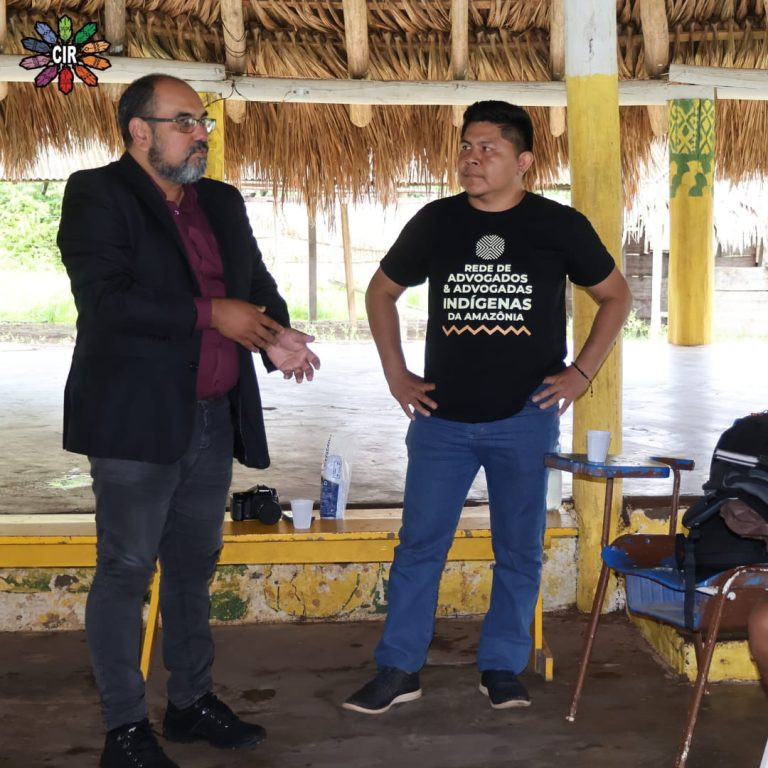
The visit to the territory was to learn firsthand about the work of the Indigenous Legal Operators Program, developed by the Legal Department of the Indigenous Council of Roraima (CIR). The program, created more than two decades ago, was designed to support indigenous regions and communities in defending their rights and territories.
“Our role in the legal department is to advise operators on their actions within the territory, following internal or regional regulations, so that it is done based on the constitution, but in the traditional way,” emphasized Junior Nicacio, coordinator of the legal department.
But the work goes beyond that, in the Pium indigenous community, T.I. Manoá Pium, Serra da Lua region and other areas. With the help of internal regulations, the Program has helped to resolve internal conflicts in the communities.
The program is competing for the Innovare Institute award, which aims to identify, publicize, and disseminate practices that contribute to improving the justice system in Brazil.
On that occasion, the internal regulations of the community, created in 2012, which address community rules, the history of the community, and the actions of indigenous legal professionals, were presented to Innovare's external consultant, Júlio de Souza.
"I'm here to learn about your practices, to understand how everything works, and also to say that the program is competing for the Inovare award, which recognizes innovative practices that have proven successful," Júlio pointed out.

The accounts of the actions were given by Chief Lázaro Wapichana, Professor Joacir Alexandre, and other leaders present.
"The regulations guide our actions regarding the punishment of problems that occur in the community. When it involves indigenous people, we resolve it here; when it involves non-indigenous people, we send it to the justice system in the city," explained Joacir, one of those who oversaw the creation of the document.
One of the questions asked by the consultant concerned the judgment of crimes and penalties. “We have a council made up of leaders and representatives from teachers, health services, firefighters, GPVTI, and other sectors, the guardians of the internal regulations. They assess the crime or conflict and, by consensus, issue the penalty, which is served within the community itself, with signature control and report production. At the end of each month, the punished individual is evaluated,” explained the Tuxaua.

In closing, Júlio congratulated the community for drafting the regulations and putting everything governed by the document into practice, and the legal department for its assistance to the indigenous communities. He also emphasized that the document is important and serves as an example for the legal actions of the states.
“It was gratifying to learn a little about your reality regarding the internal regulations and the program for operators in indigenous law, fundamental actions that help to relieve the burden on the traditional legal system, and can serve as an example to expedite problems involving indigenous people in the judiciary,” Souza concluded.
The final results of the Innovare Award will be announced in November 2024.