
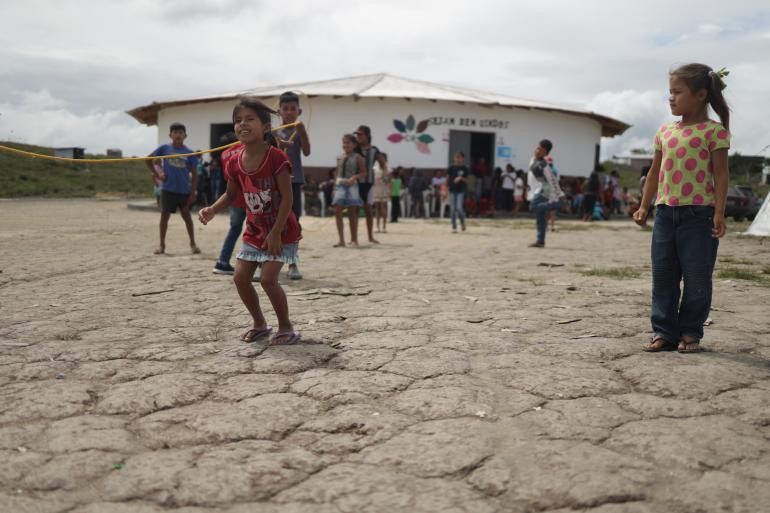
The center will serve children and young people from the community located on the border with Venezuela. Ta'rau Paru welcomes 600 indigenous refugees and migrants, who belong to the same ethnic group
The indigenous community of Ta'rau Paru, in Pacaraima, on the border with Venezuela, won on Monday a Cultural Center to carry out community activities. The new space will mainly serve children, adolescents and young people from the community of about 900 people of the Taurepang-Pemón ethnic group – of these, about 600 are Venezuelan indigenous people. The inauguration takes place within the scope of the UNICEF project in partnership with the Indigenous Council of Roraima (CIR), through the financial support of the European Union's Department of Civil Protection and Humanitarian Aid (ECHO) and the Spanish Agency for International Development Cooperation (Aecid).
The Cultural Center, whose name is yet to be defined by the community, was built in masonry in the shape of a maloca, with a diameter of 16 meters. It is equipped with 50 chairs with armrests, printer, projector, computer and other equipment for carrying out the activities. It is there that the Súper Panas de Ta'rau Paru space will operate (learn more at the end).
"It is important to seek, within the emergency response, sustainable solutions that respond to the needs of the community. This center will provide a space for the integration of children who arrived from Venezuela and those who were already here," says Marcela Bonvicini, head of the UNICEF Office in Roraima.
Located within the São Marcos Indigenous Land, Ta'rau Paru – as well as Sakamutá, Bananal and Sorocaima II, all on the border with Venezuela – is among the indigenous communities in Brazil most severely impacted by the flow of refugees and migrants from Venezuela – in turn one of the largest migration crises in the world, with 6 million people displaced.
There, just 600 meters from the border with Venezuela, refugees and migrants were welcomed: despite the boundaries between countries, they are the same indigenous people, with linguistic origin and kinship ties. But disorderly population growth – the community of 300 people came to welcome 900 indigenous people who lived on the Venezuelan side – aggravated the vulnerability of these groups.
"The inauguration of the Cultural Center is the realization of a dream of the Taurepang people, of each family and each child in the community. The space was created to strengthen diversity and value our culture even more," said Tuxaua Aldino Ferreira, from the Tarau Paru community.
According to the project designed by the community's tuxaua (chief), Aldino Ferreira, the Cultural Center is only the first central part of a larger structure that will contain other spaces for coexistence and exchange.
"Indigenous peoples have no borders. This center will improve the quality of life of children and young people, being a space for cultural exhibitions and the rescue of language and culture. It is a movement in the search for community autonomy", says the coordinator of the Department of Territorial and Environmental Management of the CIR, Sineia do Vale.
After the inauguration, the children of the community will paint the internal walls of the space in an art workshop. In all, 452 children and adolescents live in Ta'rau Paru today.
About Super Panas
The Súper Panas spaces – a common expression in countries such as Venezuela that can be translated as "super friends" – are friendly welcoming spaces that offer psychosocial support activities and non-formal education for refugee and migrant children and adolescents, integrating education and protection interventions. Their professionals also work to prevent violence and abuse. In indigenous territories and shelters, the strategy is adapted to suit the cultural specificities of these populations. In Ta'rau Paru, the intervention began with psychological care for children who witnessed armed conflict on the other side of the border.
Source: UNICEF
Indigenous community of Ta'rau Paru wins Cultural Center in UNICEF and CIR project, in Roraima