
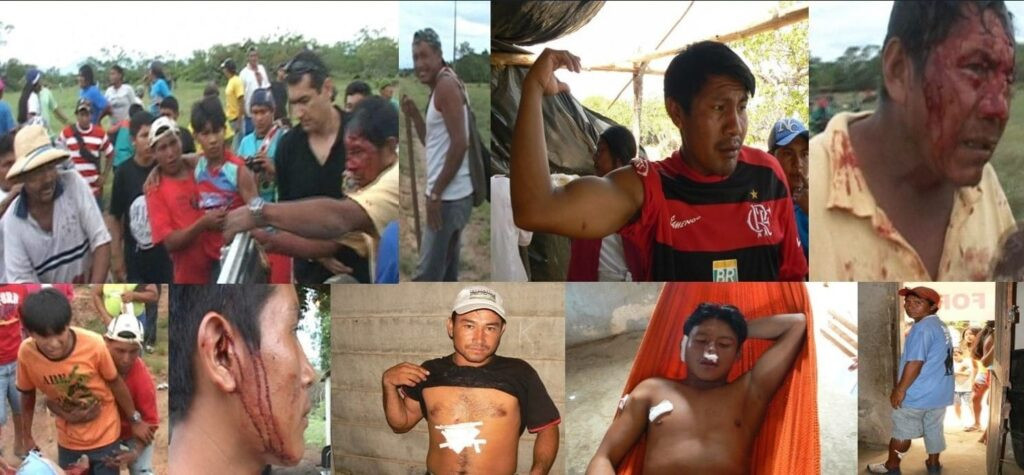
In a hearing at the MPF, victims and witnesses ask for speed in the process and punishment of the accused.
One of the extreme cases of violence against the indigenous peoples of Raposa Serra do Sol, the case of the "10 Brothers", completed 16 years last Sunday, May 5, and the main accused, the former governor of Roraima, Paulo César Quartiero, in addition to the others accused of committing the crime of attempted murder, remain unpunished.
The 10 Brothers case became known in 2008, after an attack on a group of indigenous leaders, who were carrying out a collective work of reoccupation of the territory, in the vicinity of the Renascer and Barro indigenous communities, in the Surumu region. The fact occurred at the height of the removal of non-indigenous people from Raposa Serra do Sol, with Paulo César Quartiero as the last invader, who resisted until the moment, when the Federal Supreme Court (STF), forced their departure from the territory.
After 16 years of processing in the Federal Court of Roraima, the case has gained a new chapter. On May 8, 2024, the group of indigenous people cowardly attacked, on May 5, among victims and witnesses, had a hearing at the Federal Public Ministry (MPF), the plaintiff in the lawsuit, to demand speed in the progress of the process and ask for the accountability of the culprits.
The attack on the 10 Brothers adds to the list of attacks committed against the indigenous peoples of Raposa Serra do Sol, such as the destruction of the Homologação, Brilho do Sol and Tai-Tai retreat communities, fire to the Raposa Serra do Sol Indigenous Training and Culture Center (CIFCRSS), burning of bridges, death of leaders such as Aldo da Silva Mota Macuxi and other violence. The indigenous people fear that the attack on May 5 will go unpunished and the accused, especially Paulo César Quartiero, will be released and cleared of this extreme violence.
The hearing, accompanied by the legal counsel of the Indigenous Council of Roraima (CIR), lasted at least two hours, in the institution's auditorium. The group of 10 indigenous people and other leaders, after years forgotten by the courts, were received by the chief prosecutor of the MPF, Miguel de Almeida Lima and by the prosecutor of the 7th Office, which takes care of indigenous and environmental issues, Alisson Marugal.

During the hearing, shocking images of the attack were shown, with shots from 12 and 38 caliber weapons, homemade bombs poured on the group, injured leaders and women screaming for their children and husbands, shot by the cowardly attack. With their eyes fixed on the screen, the leaders recalled May 5, and brought to the attention of the authorities this bloody day that will be marked in their memories. Silence and emotion took over the environment. Among the leaders, there was also the general coordinator of the Serras, of the Raposa Serra do Sol indigenous land, Amarildo da Silva Mota, son of indigenous leader Aldo Mota, killed in 2003, in an ambush. Amarildo recalled that the act of May 5 is another one that has been happening for 524 years, when they tried to exterminate the indigenous peoples of Brazil. When asking for justice, Mota questioned the lack of justice on the side of the indigenous peoples and asked. "If it were the other way around, there would already be a leader arrested. It's been 16 years and we've never had an answer," he demanded. "Why this injustice on our side? Certainly, if it were the indigenous communities, there would already be a leader arrested. So we came here to ask for justice, in search of our right," charged the regional coordinator. Amarildo reinforced that the shots that hit the indigenous people "were not rubber, but lead," as found in the process. "Our only objective is to occupy what is ours. Before, we could not hunt, fish and there was a lot of environmental pollution, they managed to end our streams, rivers, and today, we want to see our land recovered," he considered, the importance of the struggle for the territory and that all suffering was not in vain.

Professor Tereza Makuxi, present on May 5, outraged by the impunity of cases of violence, especially of the "10 Brothers", did not hesitate to reaffirm the reason for so much struggle for the territory, such as the environmental preservation, rivers and lakes, in addition to free and collective living. Mother of a minor victim, Tereza demanded more attention from the justice.
"We want to be heard more, we want to be more attended to and we want justice," Tereza reinforced, demanding justice in the face of the case, which occurred 16 years ago and no response was given to the indigenous people. Teresa also asked for compensation to the peoples who suffered and shed blood, such as her son, who was a minor at the time, a victim of the attack.
"We never went with a gun, we never killed and we never shed the blood of any non-indigenous person, but we shed our blood. And today, we are sorry," he concluded, questioning the repeated testimonies given to the justice system and that have had no effect on the case, to this day.
Considering the history of violence against indigenous peoples, especially in the state, the Indigenous Council of Roraima (CIR), throughout its 53-year history, has been a fundamental organization that supports indigenous communities in the face of the challenges of demarcation and homologation of territories, but also of ensuring the safety and protection of indigenous peoples.
The general tuxaua of the CIR, Edinho Batista, commenting on the context, pointed out that the organization already has a lawsuit filed against the Brazilian State in relation to cases of violence against the indigenous peoples of Raposa Serra do Sol, pending in the Organization of American States (OAS), since 2004, where, in addition to the crimes that occurred during the demarcation and homologation process, they also point to the lack of protection and territorial inspection. He said that, as an organization with all its legitimacy to enter the courts, "they have the opportunity to give visibility to the historical debt of the State with the indigenous peoples."
"With so much violence that has happened and that has never been punished, but now we can speak for us, go to justice and this we have as an initiative that can actually show Brazil and the world that indigenous peoples are part of the Brazilian State, they are people who in fact have never invaded territory, never destroyed. On the contrary, we are legitimate and original from this State," said Batista.
He also demanded accountability not only for the "10 Brothers" case, but also for others who ended up going unpunished by the slowness of the State and also for the accused themselves who tried in every way to circumvent justice and go unpunished.
The Federal Public Prosecutor's Office (MPF), whose role is to defend collective rights, has a crucial role in ensuring that another case of violence against the indigenous peoples of Roraima does not go unpunished. At the hearing, the chief prosecutor, Miguel de Lima, affirmed his commitment to intervene with the Federal Court, to move forward with the process as soon as possible. On Thursday (9), he also requested a hearing with the indigenous leaders.

TheImagesof the attack that circulated the world were made by the indigenous cameraman Aldenir Wapichana, who at the time, recorded the collective work of the leaders. He was persecuted, suffered threats and to this day, he also continues to wait for justice for this and other cases of violence against the indigenous peoples of Raposa Serra do Sol, many of them registered by him. The case became known as "10 Brothers" due to the 10 indigenous people who were seriously injured, including bullets still lodged in the body and the aftermath that marked May 5. A fact that is still difficult to be narrated by the victims, who in the midst of the few words and gestures, transmit in their eyes the memory of that day.
On the return to the territory, passing through the corridors of the MPF, there was hope, the clamor for justice, not only for the attack in the process, but for all the violence suffered throughout the struggle for land, for more than 40 years.
The scenario of violence and even murders of indigenous people extends to other territories and in current times, as pointed out by theReportof the Indigenous Missionary Council (CIMI), published in July 2023, pointing out murders that occurred in the last four years, from 2019 to 2022. The survey pointed to 281 indigenous people murdered in the state and in Brazil, 795 indigenous people.
According to the survey, the average number of indigenous people murdered in the period from 2019 to 2022 across the country was 198, that is, 75 cases per year. According to the excerpt from the report, the cases were related to the struggle for land. "The year was marked by a series of conflicts and murders of leaders and indigenous people linked to the struggle for land and the protection of their territories," says the excerpt.