
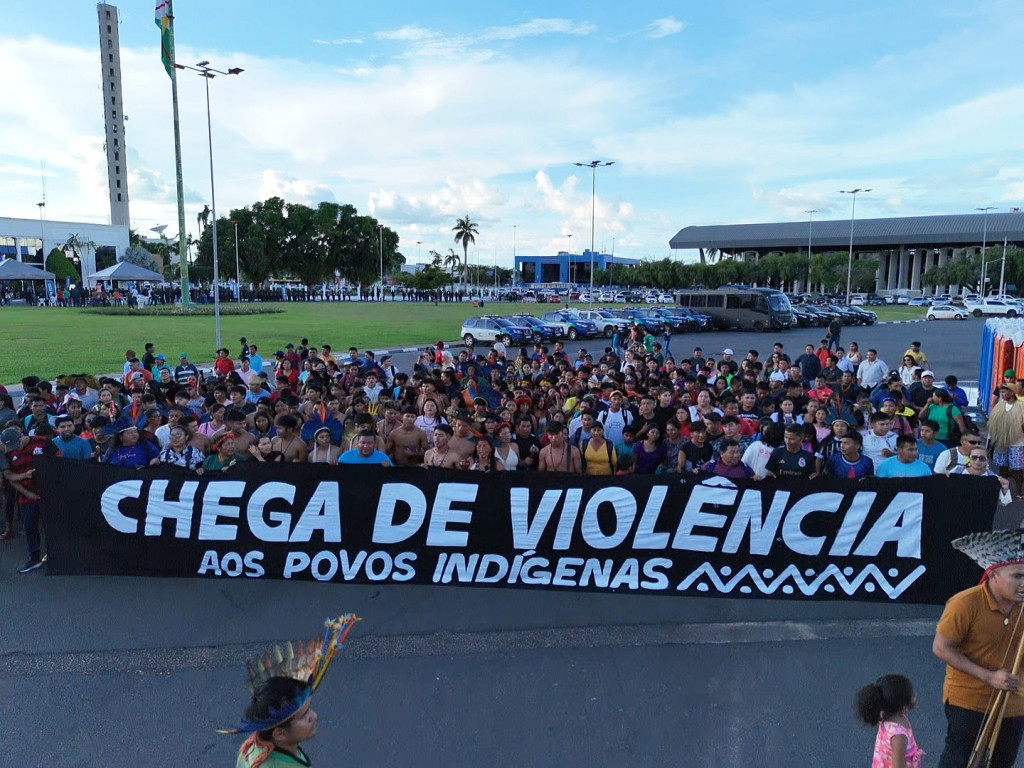
On the first day of the 5th Free Land Camp (ATL) program, in the afternoon of May 5th, lawyers from the Indigenous Council of Roraima (CIR) — Júnior Nicacio Wapichana, Fernanda Félix Wapichana, and Luciane Xavier Macuxi — presented a brief overview of the current state of indigenous peoples' rights. They highlighted Law 14.701/2023, the conciliation table established by Minister Gilmar Mendes, Constitutional Amendment Proposal (PEC) 48/2023, the Senate Working Group discussing the regulation of mining on indigenous lands, and projects targeting these territories, such as the Bem Querer project on the Branco River and oil exploration.
The so-called "time frame" thesis, defended by the rural caucus and sectors of agribusiness, establishes that indigenous peoples would only have the right to the demarcation of lands they were occupying or disputing on October 5, 1988, the date of the promulgation of the Federal Constitution. This thesis violates the Constitution itself, which declared the rights of indigenous peoples as original, that is, prior to the formation of the Brazilian State.
The Brazilian Supreme Federal Court (STF) ruled on the thesis in September 2023, in the case of the Xokleng people, declaring its unconstitutionality and stating that it does not apply to the process of demarcating indigenous lands. However, in the same year, the National Congress approved Law 14.701/2023, which, contradicting the STF's decision, regulates the temporal framework thesis and imposes other setbacks on indigenous rights.
Lawyer Fernanda Félix explained that the conciliation table established by Minister Gilmar Mendes to analyze Law 14.701/2023 is not the appropriate forum to deliberate on indigenous rights. For this reason, in August 2024, the Articulation of Indigenous Peoples of Brazil (APIB), which represents the indigenous peoples of Brazil, decided to withdraw from the conciliation table. The commission's meetings have already been postponed three times and have been rescheduled for May 12 and 16, 2025, with a projected conclusion in June.

Attorney Júnior Nicacio detailed Proposed Constitutional Amendment 48/2023, authored by Senator Hiran Gonçalves, which proposes altering Article 231 of the Federal Constitution to institutionalize the temporal framework thesis in the demarcation of indigenous lands. The PEC was presented on September 21, 2023, coincidentally the same year that the Supreme Federal Court declared the thesis unconstitutional.
Indigenous peoples classify the proposal as the "PEC of Death," as it disregards the traditional occupation of territories and ignores the historical violence that forced many communities to abandon their lands.

Subsequently, indigenous organizations and non-governmental institutions — such as the Organization of Indigenous People of the City (ODIC), the Insikiran Institute, the Diocese of Roraima, the representative of UMIAB, the State Organization of Indigenous Women (OMIRR), the Indigenous Council of Roraima (CIR), and the Kuaikri State Indigenous Association of Roraima — highlighted the importance of defending indigenous territories as an essential condition for preserving the life, culture, and rights of indigenous peoples.
The deputy chief of CIR, Paulo Ricardo, from the Macuxi people, emphasized that the mobilization of indigenous peoples has very clear and legitimate motives.“We are mobilized against the serious setbacks, against the attacks on our rights. The ATL/Brasília had a very significant effect. They are polluting the rivers, and we are the ones suffering. We need to review our strategies for struggle.”
Leirejane Macuxi, a representative of UMIAB, says that the demonstration is for life and for the renewal of the struggles of the indigenous peoples of Roraima.“This mobilization is to repeal [the laws] for the sake of the lives of the entire population. The territory suffers from agribusiness, our health is not the same. We are at the mercy of anti-indigenous politicians.”, he emphasized.
And the voices of women continued with Gabriela Peixoto, from the Macuxi people, of the Organization of Indigenous Women of Roraima (OMIR).“Come on, women, let’s occupy these spaces. We are here to develop these strategies. Let’s take on these roles.”
The chief of the CIR, Amarildo Macuxi, recalled the case of the "Ten Brothers," a crime that occurred in 2008 and remains unpunished to this day.
At the end of the day's program, the indigenous movement held a march in the square, concluding the activities with traditional songs and banners with messages of resistance and demands: "Enough of the violence, out with the time frame, out with PEC 48."
Images: ASCOM/ CIR.