
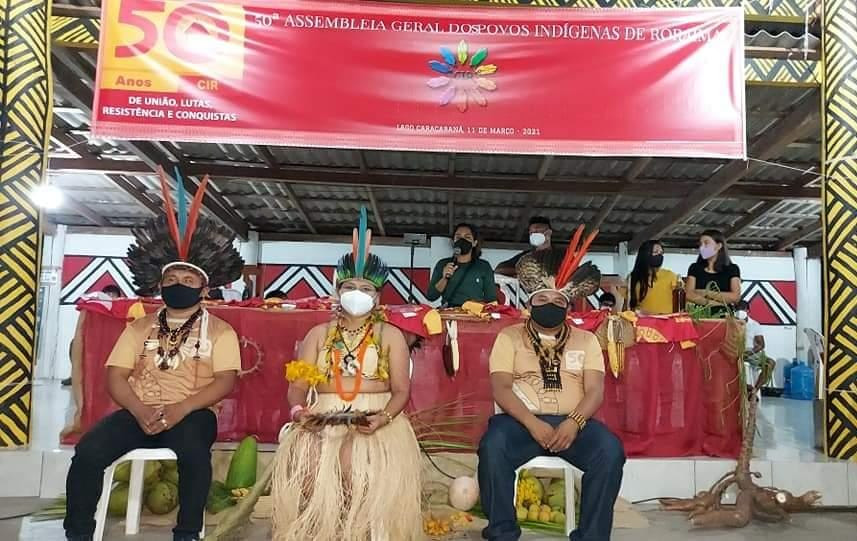
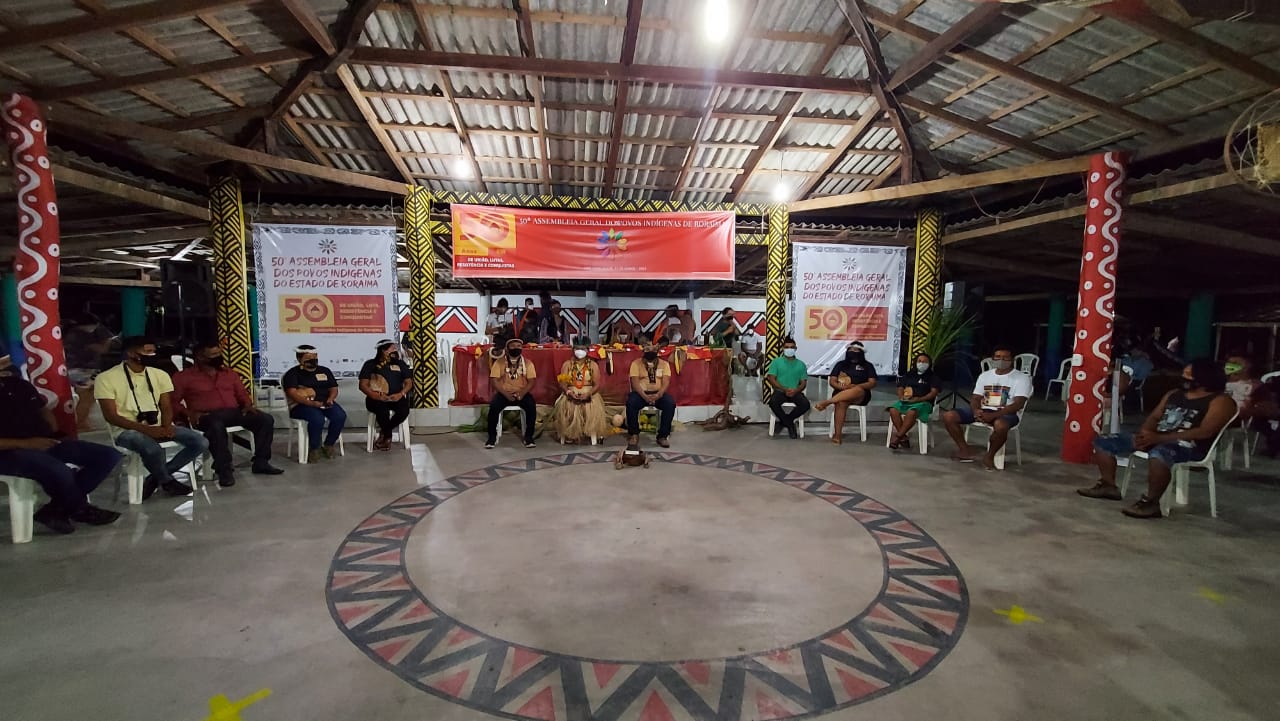
The 50th General Assembly of the Indigenous Peoples of Roraima was marked by the election and celebration of the inauguration of the executive coordination of the Indigenous Council of Roraima (CIR). The meeting took place on March 11 at the Lago Caracaranã regional center, Raposa region, Raposa Serra do Sol Indigenous Land. Due to the pandemic, only leaders with a voice and vote were able to participate and everyone had to take the rapid Covid-19 test before entering the event, wear a mask, 70% alcohol gel and maintain distance.
With the theme "50 years of Union, Struggles, Resistance and Achievements", the leaders held the inauguration celebration in just one day. The election for the coordination of the CIR began on January 5, 2021, with the delivery of the voting forms and the deadline for feedback until March 8. Representatives of 198 of the 247 communities associated with the CIR participated in the election. Along with the inauguration ceremony, there was also the pose of the new fiscal councilors of the CIR. On the occasion, the leaders approved eight more indigenous communities, and now there are 255 indigenous communities.
Edinho Batista de Souza, of the Macuxi ethnic group, was elected as the first coordinator of the CIR, with 3,606 votes, and Enock Taurepang as vice-coordinator with 3,287 votes. Maria Betânia Mota de Jesus was re-elected as Secretary General of the Indigenous Women's Movement with 5,810 votes. The candidate Fábio Gomes da Silva had 1,299 votes and Aldenicia Cadete de Lima had 2,237.
After taking office, the new general coordinator, Edinho Batista, who is from the Maturuca community, Serras region, Raposa Serra do Sol Indigenous Land, said he intends to continue the work of the CIR. He is 41 years old and had two terms as deputy coordinator between 2017 and 2021.
"Our organization will not have a coordinator, but a coordination, reelected with legitimacy to represent the communities. In theory there are bureaucratic issues, but our service is to lead, prioritize our indigenous population and continue with the work," explained Edinho.
This is reinforced by the current deputy coordinator, Enock Taurepang, of the Taurepang ethnic group, and born in the Araçá community, Amajari region. "The commitment to our organization, to the indigenous communities continues, we have come well so far, I feel obliged to do twice as well so that our organization continues to grow and to kick-start another fifty years of resistance, perseverance, understanding and wisdom, so that the communities have an autonomous institution and overcome all challenges", highlighted Enock, who was general coordinator of the CIR for four years, having taken office in 2017 at the age of 26. He held the position of general coordinator of the CIR until March 11, 2021.
Re-elected, the secretary general of the indigenous women's movement, Maria Betânia, from the Macuxi people, Aningal community, Amajari region, said that this is a challenging moment, in the face of so many threats to the rights of indigenous peoples.
"In these four years and now in the third reelection for another four years in the executive coordination of the CIR, we will set joint goals with the regional coordinators of women together with our leaders, strengthening the projects more and more, seeking more and more partnerships to strengthen the initiatives of the warriors that we have within the bases". Those elected remain in the positions of the executive coordination of the CIR until 2024, according to the current statute of the organization